Friday, March 26, 2010

Day 7 - Yuki Matsuri (Sapporo)

6th February, 2003 - Yuki Matsuri is an annual event (around early Feb) that fills Odori Koen with a huge variety of snow/ice sculptures. There's always a number of LARGE pieces, but also there's a lot of small sculptures around the place.


Given how cold it was when we arrived, you might think that snow sculptures must be pretty easy - no lack of raw materials. Actually - it's hard work... every night the sculptors are out there, either fixing, or in some cases, re-building their sculptures to avoid the tell-tale signs of melting. There's no rest for the cold here in Sapporo.

Does this look familiar... actually the donjon might... this was supposed to be a replica (in snow) of Edo-jo... remember we saw the foundation in the Imperial Palace Park.


And then there's the international flavour.... direct from China!...

There's also ice sculptures as well that dot the park.


There's also an international snow sculpting competition... Go Aussie Go!.... actually - we don't get a lot of snow in Australia... I guess their freezers must be running overtime during our summer!

Posted by Picasa

Day 7 - Sapporo Tower (Sapporo)

6th February, 2003 - There are two main ways of getting into the city... the train which takes you into Sapporo Station, and about a km away, the subway takes you into Odori Koen. I'm not sure if it's due to be finished this year, but they have been working hard on an underground mall that links the two (there is already a subway line, but now you will be able to enjoy shopping as you go). Actually, Sapporo has a large number of underground malls - there's lots of shopping to be had when winter chill makes it uncomfortable walking outside.

We took the subway into Odori Koen (the alternative entry point into the city)... which is also the location of the Yuki Matsuri.

In the background you can see Sapporo TV Tower. *sigh* if you've got a good idea.... just repeat it! Actually, though I've been to Sapporo 6 times, I've never once been up the top. I really should go one of these days, but at 600 yen, it always seemed a waste when you can just go into any of the buildings that line Odori Koen and get almost as good a view for free.

Actually another treat in Japan that I haven't mentioned yet is Mister Donuts. It's GREAT! Of course - back when I was a smoker it was even better, but it's one of the best value places in town. You can pick up any number of different types of donut and pastry products for between 100-300 yen, and you can wash it all down with "American" coffee. Basically this is pretty standard brewed coffee - but you get unlimited refills. That's right. UNLIMITED REFILLS. Ok... I don't think i've ever gone past 3...but... I'd definitely recommend Mister Donuts to anyone with a sweet tooth and a tight budget.

Posted by Picasa

Day 7 - At Home (Sapporo)

6th February, 2003 - After a strange night...sleeping in separate rooms as is good and proper for an unmarried couple ?:-( ... the next morning I was greeted with freshly brewed coffee and Okaasan's signature sakana dish... a beautiful Hokkaido salmon that was just sugoi oishii! (really, really yummy). I have to say... the next week was going to be a very good time for my stomach - but a very bad time for my waist. You might also see (in the bowl at the front) a strange thing that looks like baked beans... it's actually a fermented soy bean food (at least they called it food), called Natto. This is one of the Japanese greatest joys... but for us Westerners - somewhat like eating a pungent sock. First time around wasn't so bad... but you learn quickly! ? ; )

We had a pretty busy schedule in Sapporo. This was a bit unusual in that it was a side trip for me... but going home for T-chan... she'd been living in Adelaide, Australia for about 7 months and was quite homesick. But this was also an important time for the two of us... how would T-chan's parents react?


Well... time would tell that. First things first... i needed to get me some shoes. I had thought that I had brought some good walking shoes with me to Japan... but the first thing that T-chan's family did was insist that I go out and buy some special shoes. Normally in Sapporo, it's very icey in winter... and that's dangerous for walking. They have either stick-on spikes (attached to normal shoes), or you can actually buy shoes with inbuilt metal claws for gripping the ice. After a short trip to Shoe Plaza, and about 2500 yen later (a cheap $30 AUD) T-chan and I were ready to explore the city. It was Yuki Matsuri time... the famous Sapporo Snow Festival.
Posted by Picasa

Thursday, March 25, 2010

Day 6 - Sapporo (Hokkaido)

5th February, 2003 - Departing Tokyo late in the afternoon, we arrived in Sapporo's New Chitose Airport around 8-9 pm. We decided to take the train from the airport to Sapporo - takes about 40+mins as Chitose Airport is in the MIDDLE OF NO-WHERE. In fact if you were thinking of plonking an airport to support Sapporo - Chitose is about the best place NOT to put an airport. However - it does give you a chance to enjoy the scenery... if you were arriving in the day time.

My memory of arriving was this. Cold. It was about -15 degC when we arrived in Sapporo. That's cold even by Sapporo standards. After arriving in Sapporo Station, we changed trains - but not before catching up on some important business. Yes - back in those days I was a smoker... and Japan was smoker's paradise. Nowadays - things have changed a lot. And I quit smoking before the birth of my son (and a good thing too).

The other strong memory was arriving at the local station, and climbing up the stairs to be greeted by T-chan's mother (okaasan) and father (otousan). Yes - i was going to meet the family for the first time. That was a weird feeling.... but made much nicer by the fact that they are really great people, and I felt at ease with them instantly!
Posted by Picasa

Day 6 - Tokyo National Museum (Ueno)


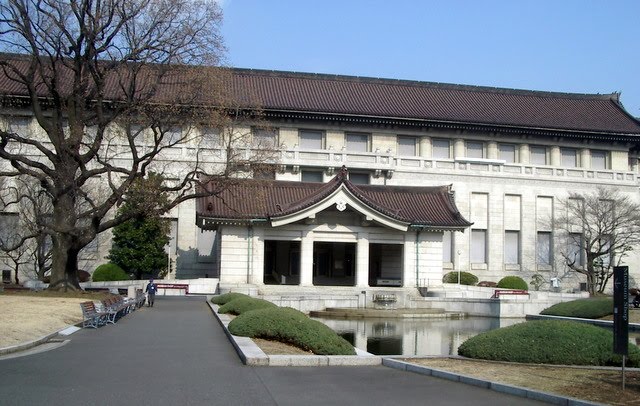
5th February, 2003 - After visiting the Yanaka cemetary, we decided that our last visit would be to the Tokyo National Museum to get some culutre - and to walk amongst even more history. The museum is quite large, and any serious exploration would take a good half a day at least. There's a good mix of exhibits crossing art, archeological, military and religious.

You can walk around for hours in here - though from memory there was a limited amount of English explanation... luckily T-chan's translation came in handy. The section on Jomon pottery is particularly stunning. Japan has long been sited as the origin of the oldest pottery in the world (at least the oldest known pottery). The Jomon pottery is around 10,000 years old, and is noted for it's roped patterns. It is strange that Japanese culture, so long surviving on the sea and agriculture had taken so long to develop during this phase of Japanese history.

Almost certainly Japan owes a great deal of it's advancement to the close ties it enjoyed - first with Korea and then with China. Especially from around 550 AD when the influence of Chinese art, learning, government - and most importantly the written language arrived and flourished. It was not until much later (several hundred years in fact) before the Japanese had devised their own written language based on kana (first hiragana then katakana).

By the Heien period, Japan had of course developed it's own unique form of military science and art - and warrier... the Buhsi or samurai. Indeed much of Japan's history can be derived (directly or indirectly) to two things... war and religion. Is it so different anywhere else?

You won't find too many tributes to Ninja in the Tokyo National Museum (though you can see some shuriken etc), but you will find a great collection of samurai armour and especially swords. Beautiful to look at - but deadly.

Posted by Picasa

Day 6 - Tokugawa (Yanaka) Cemetary (Ueno)

5th February, 2003 - The last day of the first chapter of our Japan trip. We decided to return to Ueno and catch some culture at the National Museum... but first we thought we'd try something different. Beyond Tosho-gu, there lies the Yanaka Cemetary (although this is often referred to as the Tokugawa Cemetary, after the family that ruled Japan for about two and a half centuries - and who have a dedicated section). It's a strange attraction that takes a pair of tourists like us to see a cemetary... and in hindsight, I would not recommend it (even though a short walk from the National Museum).


It is a moody place, and where you will find the good bits hidden away from view. Like the burial place of Ieysasu himself, the attraction has gone - in his case, to Nikko - leaving only a cold reminder of where we all end up (tourist or tyrant).


Posted by Picasa

Day 5 - Coffee and Monja (Ginza)

Doutor at Ginza 4th February, 2003 - After a long day, we leave the Kabuki-za and head back into Ginza. It's been a very long day and we enjoy watching the street-life from Doutor Coffee. Ginza is (if you don't know) the premier up-market shopping area (at least as far as our budget would allow us to know).

And no... I'm not married to miss smiley face :-) .... it's just that we prefer if she remain mysterious... and that we maintain some privacy in our on-line life. That's why she's called T-chan in my blog. If you're also wondering if she's been trying out for a role as Winston Churchill ("we will fight them on the beaches, we will fight them..." you know... cigar in one hand, the sign V for victory with the other) - Japanese people love to take photos making the peace sign. Don't ask me why as I've long since got used to, and indeed indulge in a bit of "V-ing" myself these days. Quite liberating really.

Monjayaki at Ginza
After an afternoon of Ginza-viewing, we started off on a search for the Godzilla memorial which is supposedly around there... somewhere. After 30 mins of getting lost - and what better place to get lost in - we decided to have dinner. Ginza has a number of smallish streets with inconspicuous cafes, restaurants and izakaya (Japanese pub-cafe). We found a nice little place that had a monjayaki (or just monja). Monja is a cabbage/flour based pancake... similiar to okonomiyaki but more watery. It's a specialty of the Kanto region around Tokyo. In Japan, there's a fair bit of cook at your own table kind of cuisine... and this is one example. It's yummy... and did I mention the all-you-can-drink-beer-offer? I put that to the test - and found that I just about did drink all that I could. In fact, I was pretty well wasted by the end of the evenings eating and drinking. I remember getting on the train, but didn't really know or care where we were going.

I never did find that Godzilla statue.

Posted by Picasa

Day 5 - Kabuki-za (Ginza)

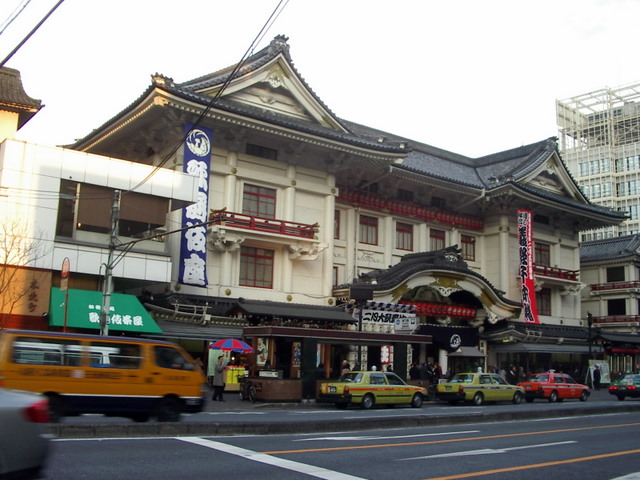
Kabuki-za in Ginza 4th February, 2003 - Time to get cultural! Leaving Yasukuni-jinja we jumped on a train and went into Ginza. Another big day. This time we thought we'd visit the Kabuki-za... I guess the main Kabuki theatre in Tokyo. Kabuki is an old form of theatre that used to be exclusively played by men (including the women's roles). Not dissimilar to the Shakespearean times in England.

Kabuki is theatre for the mainstream - at least in olden times. It recounts many historical stories - and is quite dynamic. Unfortunately we heeded the requirement of not taking any photo's/video's inside (even though we later saw many Japanese doing this). Kabuki plays are generally long, however, if you go here you can catch a single act (there's like a short-term stay area near the back of the theatre which you can get tickets for about 1000yen.

The show we saw was mixture of history/action. Lots of swordplay, quite a bit of humour and did I mention the revolving stage? Very interesting! Well worth a visit if you are around Ginza and need a break from all the expensive shopping. Don't be surprised however if during the performance, people from the audience cry out... it's part of the tradition, like ritualised heckling I guess. Omoshiroii!
Posted by Picasa

Day 5 - Yasukuni Jinja (Chiyoda)


Yasukuni-jinja torii


4th February, 2003 - From the Imperial Palace, it's not too hard to visit Yasukuni-jinja, one of the more infamous places in Tokyo. By itself it's a rather imposing (if perhaps not so spectacular) Shinto shrine - as evidenced by the GIANT torii gate on the approach - to the Japanese fallen soldiers. The great contention with Yasakuni-jinja is that a number of "war criminals" from WWII are interred there. Visits by Japanese politicians inevitably raises a great clamour around Japan and much of nearby asia as evidence of some right-wing intentions by the Japanese government.


That's most probably a little disrespectful to the inumerous other soldiers souls that this shrine honours (actually, it's numbered at 2,466,000 souls - give or take). This is the equivalent (I suppose) to a shrine of remembrance in a western sense.

The original shrine was built following the Meiji restoration, and is therefore quite new by Japanese standards.

Mid-July is apparently a good time to see the shrine, during Mitama Matsuri (mid-summer festival), when the approach is lit by thousands of lanterns.
Posted by Picasa

Day 5 - Tokyo Imperial Palace

Imperial Palace Tokyo 4th February, 2003 - Imperial Palace. Before coming to Japan, you may have visions of a stately and refined castle atop a slight rise, or perhaps a wide Heien-style building with long sweeping corridors. The Imperial Palace is - in a word - unseen. Of course you can google photos of it, but you won't be likely to see it yourself. The most you will see is the watchtowers that dot the walled moat, and the causeway and bridge that leads into the seculuded world of the Imperial Family. It's a far cry from good old Buckingham Palace in England. Don't go expecting to see hordes of people trying to catch a glimpse of royalty (at least my experience was of relative solitude). However, do go if you think that the mystery of what lies behind the walls won't be too crushed by not really getting any answers.


Donjon in Edo-joThe original Edo-jo, or castle that was the seat of power in Tokyo (or as it used to be called, Edo). It was established around the 1450's and then later became the Tokugawa's stronghold during the shogunate of Tokugawa Ieyasu. The popular image of Japanese castles of have huge 5 or more storied towers (called donjons). Indeed Edo-jo used to have the highest donjon in Japan (built in 1607), however like many of Japan's history it was destroyed by fire (only 50 years after construction) and never rebuilt. The remaining foundation is still visible within the outer Imperial grounds gardens.

Bridge Imperial Palace Tokyo

Day 5 - Imperial Palace (Tokyo)

Kusunoki Masashige in Tokyo Imperial Palace Gardens4th February, 2003 - On our way to the Imperial Palace. An interesting insight into the contradictions of modern Japan occured on the way to the Imperial Palace. In the gardens on the approach (in Kokyo Gaien) there is a statue of an imposing Samurai warrior atop a charging steed... sword at the ready to take your head in one foul sweep. His name was Kusunoki Masashige (1294 -1336), and he was a loyal samurai for the Emperor Go-Daigo. If you remember (from Kamakura), he was the Emperor that finally put an end to the Kamakura shogunate of the Taira and the Hojo. Kusunoki was instrumental in that battle with the anti-Imperial forces.

The strange thing was - that as we stood admiring the scary (kowai) attitude of the statue, an ancient woman (she might have been 150 to look at her) was standing before the statue as if in prayer. It was only as my wife listened that she could gather that she was reciting an oath to the Emperor (at least she thinks).


It was the fervent seriousness of her stance that was so unsettling... I understood then and there that Kusunoki had never had to come up agianst anyone as scary as this small, determined obaasan. It also reminded me that Japan in the midst of it's economic tidal wave (both up and down) still held onto it's old beliefs. It made me think, how far below the surface did these feelings of a previous better time, and of loyalty to Japan (whatever shape that took) lie?

The old spirit remains strong.
Posted by Picasa

Wednesday, March 24, 2010

Day 4 - Tokyo Tower

Tokyo Tower3rd February, 2003 - Tokyo Tower. It is called the fake-Eiffel tower, and it's easy to see why. It is an almost self-proclaimed tourist trap that sucks people in... it's shiny red and yellow glow a siren call to leave your good sense behind. It is a bit cheesy - yes - but, then again, it's hardly a trip to Tokyo without indulging in a bit of sentimentality.

Waiting at ground level you wonder if this is he end of the day that you really expected. It's been a long tiring day...The ride to the top is smooth and quick - then the doors open out and you find yourself on the observation deck. It feels quiet tonight; a bit like a chic club that celebrates it's not-quite-popular-status. Perhaps it's glory day has passed - or perhaps it's us as visitors that approach the tower with a certain cynicism. Still - for all that we walked around studying the neon and fluorescent skyline. This is Tokyo... and the Tower stands as an ever present reminder of that fact.

For the adventurous, there's the standard thick perspex floor window, allowing you to stand cm's from a cold and silent death drop. Ok - it might not be the Syndey Harbour Bridge climb, but for those of us that have a discomfiture of heights it's enough of a thrill.

Had a nice coffee here, foot-sore and yet feeling romantic... and still the night was young. The moral of the story is - enjoy Tokyo Tower because it is an uneasy (and perhaps slight dated) icon of Tokyo!
Osukaresama deshita!


Posted by Picasa

Day 4 - Zojo-ji (Minato)

Zoujou-ji in Tokyo 3rd February, 2003 - After walking some distance (always towards the tower) we came across Zojo-ji (or Zoujou-ji)... which was established around 1393 AD... but like many other such temples was significantly damaged during WWII and remade mostly out of concrete. Behind the temple, Tokyo Tower looms over the surrounds, like a giant rocket ship ready to take the enlightened few to a much better place. Australia?

Zoujou-ji is also rather well known for it's Jizo statues that surround the temple like some mystical totem fence. The Jizo are there to represent the lost children (or those that died in childbirth), and indeed are where the ashen remains are stored. It's an eerie feeling walking past these sad, beautiful statues, their sad innocent expressions, their hand made windmills catching the last rays of sunlight.The children's clothing is meant to protect them on their solitary journey.  A sobering and moving experience.


Posted by Picasa

Day 4 - Sumidagawa Cruise (Tokyo Bay)

3rd February, 2003 - After having enough beans to have any number of halucinations and out-of-body-experiences - and still not seeing the famous golden Kannon statue of Senso-ji... we decided to look for our own golden statue...in the river (if you've seen the Asahi building in Asakusa, you''ll that there's gold to be found in them thar hills.... it's a big giant golden poo (see to right).


Sumidagawa Cruise from Asakusa
Then we took the Sumidagawa cruise that departs nearby the Senso-ji temple. It's not the most romantic, or for that matter the most scenic of river cruises, however, it does provide a very unique mode of transport to move around Tokyo, and ends up within a short walking distance of the Tokyo Tower.


Posted by Picasa