Showing posts with label Garden. Show all posts

Sunday, November 28, 2010

Old Hokkaido Government Building... Made in USA (almost)

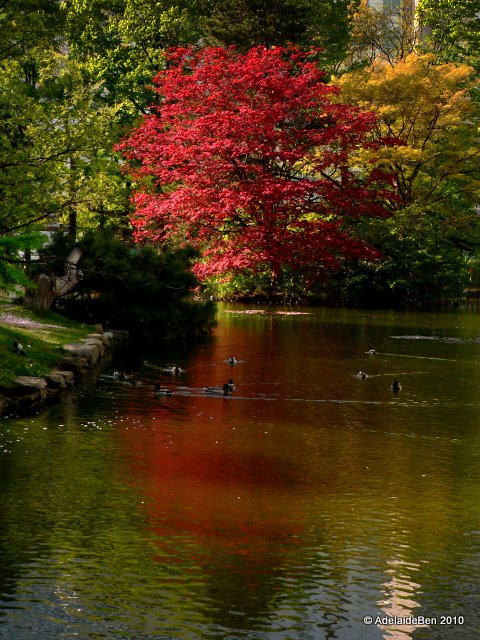
13th May, 2008 - Following on from our walk around the Botanic Gardens, we took L-kun for a walk around the Old Hokkaido Government Building near the Grand Hotel (actually the Grand is where we had our pre-wedding party back in 2003). Last time we were walking here it was February 2003... and there was quite a different look and feel to the place this time around (something to do with being able to feel your extremities I suspect). At that time, it was snowmen rather than flowers that dominated the scenery. On this occasion, cherry blossoms, not snow, formed a blanket on the lakes surface.

It's often easy to get the view of Japan as an ancient and homogeneous country, and in many ways this is true. However, Hokkaidō is a relatively new addition to what is traditionally considered Japan. It was initially populated by the Ainu people, a culturally, linguistically and racially different people from mainstream Japanese.  As is often the case with aboriginal peoples, they had a somewhat difficult time coming to terms with maintaining their own way of life, whilst trying to cope with the external Japanese expansion from the south. In fact, it was not until the Muromachi Period (from the mid 1300's) that a form of permanent Japanese presence came to the island, though this was always a somewhat loose form of feudal Japanese control.

It was not until the Meiji Restoration that the Northern Island of Hokkaidō was fully opened up... both as a response to the pro-shogunate forces that had established a break-away province which was finally crushed in Hakodate in 1868 (during the Boshin War) - but also as a response to the growing threat of Russian expansion. As a result, the Japanese population of the island increased five-fold in the space of 10 years. The newly developed city, established officially in 1868 also became the capital of the island; the original government building can now be seen in the Historical Village in Sapporo. With the reformation of the political structure of the island, a new Government building was constructed based on a very American inspired design. Actually, whilst the look was very much American - the actual design was Japanese. 

The Hokkaidō Government Building (Hokkaidōchō kyūhonchōsha) was actually destroyed by fire in 1909... though apparently the tough old red-brick exterior suffered little damage. Now those red-bricks provide a somewhat jarring counterpoint to the modern Japanese buildings; in addition to the octagonal dome which was all the rage back in the States at the time.

These days the building is known not only for it's distinctive architecture, but also it's beautiful gardens. And tulips form a dramatic focal point come spring-time.

But the grounds contain a nice assortment of trees and water features, and you can have a good stroll through the extensive gardens. It's only about a 5-10 min walk from Sapporo Station, and is well worth the time. Admission to the grounds and building is free.
There were a couple of Americans who were central figures in the agricultural development of Hokkaido during the early days of the islands re-development - one was Horace Capron, and the other was William S. Clark who started the first agricultural college in Japan, and who is famously recorded as saying (in parting the city and country), "Boys, Be Ambitious!".  These words can still be seen remembered in the city of Sapporo. And as I look into the eyes of our son (through the stroller cover), I could only hope that this spirit of adventure and the shaping the unknown could be captured by him. L-kun, be ambitious - but above all, be a good boy! Onegaishimasu.

Monday, November 22, 2010

Hokkaido Botanic Gardens - A Splash of Colour and History


13th May, 2008 - Spring time in Sapporo is beautiful, and full of life. Which is a good thing, because Spring is relatively short. After a long week of being at home relaxing, we ventured forth again with L-kun. This time we wanted to go into the city and visit the Hokkaido Botanic Gardens (Hokkaidō Daigaku Shokubutsuen).


View Larger Map

And if you're looking at the maps, check out StreetView... as they've implemented a great idea here... a higher than normal definition walk around the garden paths. This is a great feature.
Photo taken from Google Streetview... or is that Parkview

These gardens are actually formally part of the Hokkaido University, and as such they are as much about learning as they are about enjoying nature. They were established in 1886, and are the second oldest botanic gardens in Japan.... but not quite as old as the Botanic Gardens back home in Adelaide which pipped them by only 30 years or so. Still, the city of Sapporo was effectively born only in 1868, so it is very much an integrated part of the city.

There are a number of different parts to the gardens, each section having it's own ambiance. The first section that we entered was brilliantly colourful, with lots of flowers in full bloom.

Now, I've said it before, and I'll say it again. A green thumb is definitely not part of my anatomy... so expect a lot of long uncomfortable pauses if you want to ask me specific botanic questions.

It may not be surprising to you that one of my favourite flowers is actually that from the Rhododendron... the bright red flowers may be a little on intense side, but there's something very unconditional about the flowers. Our climate isn't so good for them back in Adelaide, but one of my favourite spots is the Rhododendron Valley in the Mount Lofty Botanic Gardens.

I sometimes wished that I had half a clue when it came to plants and gardening... but I don't think Rhododendron's do well in the hot dry climate of the Adelaide plains. The soil almost certainly too alkaline for these to grow well without a whole heap of conditioning.

There is a good use of water in various parts of the gardens. Never enough to dominate the experience, but just enough to add a sense of stillness.

And with it you can just relax and let the tension flow out of you as you look at the slow-motion explosion of colours and textures of these flowering plants.


There is quite a large area within the botanic gardens that looks... well... like a forest. In fact, it looks like a perfect place to understand what the natural forests had to offer, without having to go out and find a native forest to go exploring in... as you never know what kind of strange creatures you might come across inside such a forest...

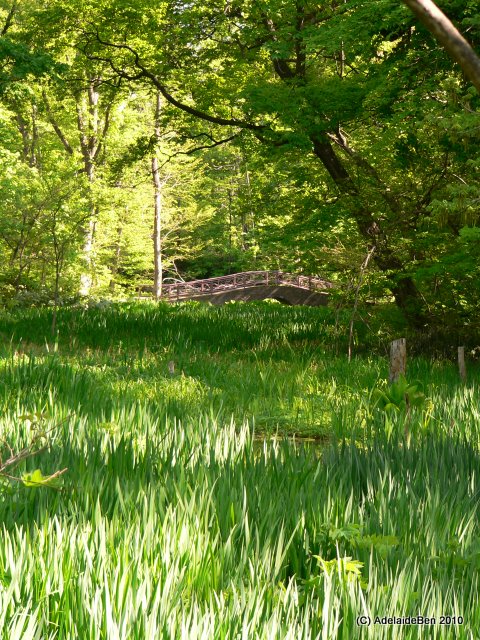
Once again, the use of water, and in this case the grasses that grow by the waterways is quite beautiful. The bridge in the distance just adds to that feeling like you may have just stepped into a painting.

There's also wide open grassed areas within the gardens made from Kentucky bluegrass. Now that doesn't really have a Japanese ring to it.

Lilacs are possibly the most quintessential flora for Sapporo - which is interesting as they're not native at all. Lilacs were brought over from the USA by the Christian educator Sarah Clara Smith in 1890, from which point they spread quite extensively. Whilst the Lilac has now become closely associated with Sapporo (which holds a Lilac Festival later in May each year), it was only selected by popular vote as the symbolic tree for the city in 1960. Actually, T-chan has a slightly tangential association with the Lilac, as she attended the school Hokusei Gakuen Girl's High School which Smith had established along with her Lilacs. During the war, the trees were cut down (not sure if we should read anything into this) - but they sprouted forth once more after the war was over. And so the legend was born.

And whilst the sakura were well and truly past their prime in Maruyama, in the Botanic Gardens they were still going strong...  This variety certainly was vibrant... but completely overpowered by the most beautiful blossom of them all, my gorgeous wife T-chan.


Yet another homework piece.... ah, it's going to be a busy week.

And all the time, the ever present Karasu (or crow) looks on... it's haunting (and let's be honest, annoying) cry echoing across the Park. Actually, this picture might suggest only a single, lonely Karasu... oh no.. there were 10's, if not 100's of them... well at least 10. Karasu are the plague of many Japanese cities for the reason that they are scavengers, and will scavenge in the neighbourhood refuse which is typically gathered in a single spot on the roadside awaiting collection. If the rubbish isn't properly covered, good ol' Karasu will find a way in and before you know it, the rubbish will have found a way out. I think they are pretty well universally despised within Sapporo at least.


Once again, the use of water in the garden is subtle and yet powerful. The elevated path winds through a shallow lake filled with all manner of different water plants. At least we think it was shallow, as we were pushing our stroller with a now sleeping L-kun in it. And a good thing to, as the broadleaf plants are known as skunk cabbage... not something I'd like to fall into.


Our experience of the Botanic Gardens was one of pleasant surprise. It's not a particularly showy garden, and in parts looks downright native. However, as a respite from the city (like it's Adelaide counterpart) it makes for a relaxing stroll, not just through the gardens, but also through a slice of Sapporo history.

Friday, November 5, 2010

Fifth Trip - Hanami Time in Sapporo (Just)

3rd May, 2008  - So we arrived in Japan, our fifth trip together - but (obviously) the first time with our son. We had been stressing out about how we would go on the flight over with L-kun, but the truth is he slept almost the entire way from Adelaide. However - such was our anxiety (as newbie parents) that we forgot to take any snapshots of our trip over. Or even our first day in Japan.

We had planned the trip to coincide with the sakura (cherry blossom) season in Hokkaido... however, like many things in life, it didn't quite work out as planned. Now according to local speculation, the peak season in Sapporo should be around early to mid-May (which is much later than most of Japan due to the colder temperatures in Hokkaido). Now this was the start of Golden Week (when there are 4 public holidays strung together... but I'll talk more about that later... today was Constitution Day. Yeah! In a normal year, the Cherry Blossoms peak throughout Golden Week, being a very convenient though busy time to enjoy a spot of hanami (flower viewing). This year however, the flowers had come early... in fact the earliest in 23 years (or so I read). 


The best place in Sapporo to go for hanami is Maruyama Kouen, which sits adjacent to Hokkaido Jingu (shrine). This is where thousands of people go come Spring... so if you like avoiding crowds, try to avoid Maruyama Kouen. And what do you do when you go to hanami in Hokkaido? Well, typically gather a group together, rent a bbq (specifically jingisukan), bring lots of food and drink - then spend the rest of the afternoon/evening there getting decidely merry. Unfortunately, this year the blossoms were already saying "sayonara"... so it must have been a slightly muted experience for all of those thousands of people.

Now, before I go any further I should first of make some introductions... (without my usual smiley faces... maybe there's hope yet that T-chan will be happy to have her photo's up)
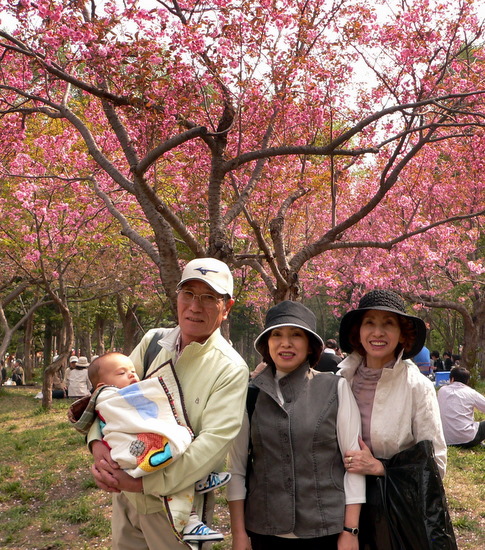
(left to right) L-kun, Otousan, S-Obasan, Okaasan

Anyhow, I guess L-kun is the easy one to pick from the photo above (it was a cool day, hence the blanket). On the left is my father-in-law (otousan=father) and on the right my mother-in-law (okaasan = mother). In the middle is my "auntie-in-law", let's just call her S-obasan (obasan = auntie).

Whilst I mentioned that the cherry blossoms were on the way out, of course, there were a few left. You'll note that these sakura are not the typical white ones that we normally associated with cherry blossoms... but rather a beautiful pink shade. Actually there are a number of different varieties in the park... with over 1700 cherry trees within the park itself. Actually - there are three main varieties: yamazakura (mountain cherry), ezo yamazakura (Ezo mountain cherry - which is also known as known as the Sargent's Cherry. Note Ezo is also written as Yezo which was an alternative name for Hokkaido), and finally the somei yoshino zakura. I'm definitely not an expert at discerning the different types... but somethings can just be enjoyed.
Yezo Yamazakura (Yezo Mountain Cherry)
  
There were white sakura blossoms. When the blooms have lost their petals, they look more like the traditional flower.... but they had definitely reached the end of their peak.
Yamazakura

The sakura below bloomed in abundance... though so the story goes, you can search your whole life and not find the perfect blossom. No matter how many there are. Having said that... why would you want to? Those crazy Japanese... always looking for answers to slightly oddball questions.

This was my first experience with cherry blossoms, and I have to admit that I was a little disappointed (that we'd arrived so late to miss the main show). However, we had a fantastic picnic lunch and L-kun enjoyed himself tremendously... especially when the wind picked up and we were showered with blossoms... a phenomenon known a sakura fubuki... or cherry blossom snow-storm.

There were other blossoms going strong at the time... for example Maruyama has a lot of plum trees as well that bloomed in just as spectacular a show... We enjoyed these blooms slightly more as they were still at their peak. Though they lack the beauty of the cherry blossom, they made up in sheer presence.
Plum blossom
I guess the lesson here is that going to Japan to see the Cherry Blossoms is always a bit of a gamble... unless you can (1) stay a long time either side of the peak, or (2) have the flexibility to travel to find the blossoms which take several months to travel south to north through Japan.

We've been trying to celebrate our own hanami back in Adelaide... but it's not quite the same thing.

One of the things that I had not quite expected however - that did come as a very nice surprise - was the amazing display of colour from the tulips that were planted around the front of Maruyama Kouen (and for that matter all over the city). Sapporo definitely has a tulip fetish, and they can be found growing every where.. even on the sides of the roads. Indeed there's even a variety of Tulip named after Sapporo.

Certainly - they grow well here, and provided a splash of colour that really did bring home the fact that it was Spring-time in Japan.

Friday, October 1, 2010

Kyoto Gosho - Emperor For A Day


1st November, 2006 - After a long day of temple-watching the day before, we were at a bit of a loss... we had plans for the afternoon, but had a free morning. That's not to say we didn't have something up our sleeves - we just didn't know if we'd have the opportunity to do it. About twice a year, the Imperial Palace - Kyōto Gosho - throws open its doors to the public. Today was one of those rare days. Could we resist... Alas - no, we couldn't. So after a quick bout of morning sickness, my wife and I headed out for a new adventure.

The last time we were here (only 10 days ago) there were similiar numbers of people to see the Jidai Matsuri. Now - they were massing, in their thousands, to have a peek inside the Palace walls. So without further ado, here we go...

The first stop is the Shodaibu-no-ma... the rooms set aside for visiting nobles, where they could await an audience with the Emperor.


Shodaibu-no-ma

The original Imperial Palace, constructed in 794 AD, was actually built on a completely different location... to the west of Nijo-jo. The original Palace was huge, at about 1.4 km x 1.16km...a substantial portion of the original footprint of the city. Now, only the Inner Palace (Daidairi) remains in the current location. The castle was burned down in 1177 AD (along with a number of other calamitous events) which lead the Emperor to be re-located to a temporary palace near Kobe. On return they re-established the Palace in it's present location. The Palace was rebuilt by Nobunaga, then destroyed in 1788, and again in 1854. It was finally rebuilt in 1856, in a much earlier style... perhaps a sign of the changing nature of Kyōto from Capital to cultural treasure.

Alas - the Imperial Palace has lain vacant since the Meiji Restoration... so no opportunities to rub shoulders with Emperors today. The palace represented both the home of the emperor and the seat of government. 

Waiting in style - Shodaibu-no-ma.

On the return of emperor to Kyōto, the present site was chosen based on the temporary palace that had been used in previous fires and calamities. The construction was completed in 1331. The current buildings however date from 1855 after fire destroyed the palace.

Two noble-women indulge in a game of Go... deep in concentration (and varnish).

Gekka-mon

Kenrei-mon
In the south eastern corner lies the solitary, and somewhat aloof building known as the Shunkoden, which reputedly held the Sacred Mirror (Yata no Kagami) - one of the three Sacred Imperial Regalia. The other two were the sacred sword, Kusanagi, and the sacred jewel, Yasakani no Magatama. These are the items that provide sacred sanction from the Gods of Japan, that the Imperial family do indeed hail from godly origins. The mirror is no longer held here however...
Shunkoden

The main hall is known as the Shishinden (below), is also known as the Hall of State Ceremonies, and is surrounded by a garden of white gravel.

The Shishinden (and idiot) as viewed from Jomei-mon.
There are 18 steps leading up to the main hall, for the 18 levels of nobility. In the centre sits the Imperial throne (above) from the 1915 enthronement of Emperor Taisho. The front of the building is framed by a cherry(right) and citrus tree (left)... just as was seen in Heian Jingu.

The Shishinden and citrus tree


"Shishinden"... just in case you had missed it

In the middle of the Shishinden is placed the original throne that was used in the 1915 enthronement of Emperor Taisho.
Throne in the Shishinden (Hall of State Ceremonies)

The Seiryoden (the Serene and Cool Chamber) was originally the residence of the emperor, and was used through to the 11th century. This building was re-created in 1790 on a slightly smaller scale. It was originally the official residence hall, but came to become another ceremonial hall... The design, in the shinden-zukuri style with cypress bark roof, is typical of residence designs of the later Heian period.

The Seiryoden... not a good place for a zombie out-break

The ten room hall can be converted into a single open room through the removal of walls and doors. The main room also holds an imperial throne, framed by a Korean dog and lion statue.

The Seiryoden
To emphasise the official nature of the hall now, in the centre is located another of the Imperial Thrones... this one known as the Michodai.
Michodai...(Imperial Throne) - protected by pair of Korean dog (left) and lion (right)
To the left of the throne lies a sacred area, with a granite floor, where the Emperor could make symbolic contact with the earth in order to worship his ancestors. When he wasn't doing that however, the stone floor was covered with white sand.


To the west of the Shishinden can be found the Kogosho, or Little Palace... that overlook the Oike-niwa. This is a 1958 reconstruction of the original... which was destroyed by fire in 1954. The story goes that fireworks from the nearby Kamogawa summer fireworks festival landed on the cypress roof and before you knew it, Wham-bam-thank-you-maam.... a new twist on the Imperial fireworks festival. To the immediate north can be found the Ogakumonjo, another series of waiting rooms where poetry reading would often be undertaken.
Ogakumonjo...
Now the Kogosho is a stage for various tranditional court kimono.


A notable feature of the palace is the gardens, including the Oike-niwa. The former was designed by Kobori Enshu (1579 – 1647) and Emperor Go-mizuno-o. It was originally fed by water from Biwa-ko through an underground pipe, but is now supplied by a well specifically constructed for this purpose.
Oike-niwa Pond (looking north)

Oike-niwa Pond (looking south)
To the north of the Oike-newa, can be found the Otsune-goten, the Every Day Palace, became the actual residence of the Emperor once the Seiryoden had been overtaken by official engagements.

Otsunegoten Imperial Villa


Paintings in the Otsune-goten


Painting detail


 Gonaitei was the private garden of the emperor, and included a tea-house. It makes for a nice way to end the tour of the Imperial Palace...
Goneitai - Emperor's private garden


The open days at Kyoto Gosho are a mixed blessing. The visit is free, and you don't need to book through the Imperial Household Agency (which would normally be required). However - you don't get the tour in English (as you do with the official tours), and you have to mix it up with upwards of 10-20,000 people at any given time...(guesstimate). The official tours are a bit of a pain to get on (see here for the details) - they don't run on weekends, and you need to book ahead of time generally.

As for the Imperial Palace itself - well, it's not what you call grand, and I have to admit that the heavy use of mannequins puts me off, big-time. However, as a way of seeing at least a re-creation of an Imperial court, it's not bad. Just don't expect to be able to head off and explore anywhere.... both the official tours and the public openings are carefully directed.
Posted by Picasa