Showing posts with label Buddhism. Show all posts

Friday, December 16, 2011

Bon Odori - Dancing Through the Veil

14th August, 2010 - Every year, come the middle of August - at least in Hokkaido - something mysterious happens. It's known as Obon, one of the most important ritual festivals in Japan (outside New Years). It's traditionally associated with the return of the spirits of the departed to the world of the living for 3 days of the year (typically the 13th - 15th of the month, but more on that at the end). It's an important part of Japan, yet, I had not experienced it before... and was kind of curious. The original plan involved going to the city to see the Bon dancing in Odori Kouen, however, it was a big day, so we instead decided to have a look at one of the local dances in the neighbourhood. Disorganised as normal, we missed the start... just...


Now I'll give a quick description of the popularly believed Buddhist origins of Obon (as sourced from the Shingon Buddhist site). I say believed, as obon, like Christmas, is most likely an amalgam of different meanings. The day almost certainly takes its name from the Buddhist Urabon Sutra - which itself is a transliteration of the sanskrit Ullambana and which means to "hang upside down". This sutra tells a story of Mokuren Sonja, one of Sâkyamuni Buddha's disciples whom had supernatural powers (of course) which he used to find his deceased mother... only to discover that her soul had fallen into the world of Hungry Ghosts and was suffering immense pain. He then asked Sâkyamuni for guidance, to which he was told to make offerings to the priests coming back from their summer retreat. Which he did, with the result: - problem solved. [At this point in the story, I do pause and reflect on the commercial acumen of mystics back in those days... nice one Buddha!].


It's actually not that easy to find reliable info on the web [the irony of this statement does not escape me], but according to one of my books ("Japan: How We Breathe & How Our Hearts Beat"), obon's origins were in fact found from a much older seasonal tradition. Indeed New Year and Obon marked the transition between two halves of the calendar, and both involving ancestor worship and the offering of crops for thanks and for prayers. It was supposedly later that this was combined with urabon-e, and combined with the Chinese traditions of filial ties. Yet still, at it's heart there lies the tradition that like the Chinese Ghost Festival, or even Samhain (one origin of Halloween), for a short time the veil that separates the living from the dead is lifted. In this case, thankfully only for the spirits return home, to be honoured by their family. Indeed, obon remains a time when families return home from all over Japan to be together.

The dance, bon odori, originates as a welcome to the ancestors spirits, where the dancers would visit homes of people who had deceased during that year. I've also read that the dance may have originated from the buddhist monk, Kuya Shonin in the Heian period, but really the custom that we now know became popular in the Edo period... in fact was so popular and grew to such extravagance that the dance was officially banned between 1673-81 AD. 


The dance itself involves a large open space, in the middle of which is constructed a tower or yagura, upon which the musicians (and drummers in particular) are positioned. Around the yagura are a number of concentric circles, along which the participants dance. The dance is slow, rythmical and often based on local traditions... for example in Hokkaido, the fishing song Soran Bushi is apparently popular (though I can't recall it at this bon odori).

The following video is a bit of a grab-bag of the dance. Unfortunately the video is pretty crappy - apologies for that - but you get a bit of a sense of the music and the movements at our local bon odori. Actually, this was about the end of our videocamera, that just died in terms of it's autofocussing. Perhaps the spirits of the dead didn't appreciate my camera skills [insert spooky music here]...WOOOOoooooohhh.

It's a community event as much as a religious one... and indeed it's perhaps moved beyond religion to be just another thread in the fabric of Japanese life.  It's also a family occasion with lots of small children with the their parents. And indeed the first part of the evening is dedicated to them with fun and games (and even giveaways to the best child dancers). 


It's nice to see the yukata, or summer kimono, which is often worn out to special events such as this (and especially to fireworks for some reason).


Apart from the occasional yukata - worn predominantly by the very young and the very old - this was a fairly casual neighbourhood events. It's not quite to the standard that you will see in some areas, but I sort of think that's not important. Instead it's a occasion to bring community together - and I have to say that the dance itself is not unlike the mass-hypnotic dances that you might read about in tribal areas.. it is quite repetitive (in a good way) and quite rhythmical. The beat of the drum stirs something in your heart - even if your not Japanese.

I'm not sure if this is something new - but there was a fairly large emphasis also places on best costume-style awards. Not unlike a Halloween influence. And I have to admit that most of the theme costumes escaped me... for example the person that dressed up as what I think was a Stonehenge megalith. I'm not sure why, but they deserved a prize just for wearing that on such a hot night. And given that it's in the middle of a hot Japanese summer, there's always lots of beer being consumed. So it's quite a lively social event, at least in the neighbourhood. 

And of course - there were other strange costumes being worn. For example some gaijin fool and his child decided to dress up in their jinbei - a traditional summer clothing in Japan, but not the sort of thing you'd see someone wear down the street... let alone in front of hundreds of people. I'm sure most of the people were wondering what the... especially when the two of them started joining in the dance. Ah... what fools... But of course, that's me. And always the shy type, it took a lot of encouragement (yet surprisingly no amber courage) to get me up. Even though we stood out like sore thumbs (even amongst the megaliths) I didn't once feel out-of-place, and indeed I think the festive mood was just positive all around.

Now I have to admit something - until recently (about 5 mins ago) I had assumed that obon was celebrated at the same time everywhere in Japan, but when they switched from a lunar to a solar calendar (way back when...), the nation split on when to recongnize obon - with some areas having a July Bon (especially in Kanto region), others celebrating it in mid August, and even others maintaining the old lunar calendar timings. Supposedly, one of the reasons why obon was held in August was due to heavy farming workload in mid-July that didn't leave any time for preparation. It just goes to show that after many years of going to Japan, that you still can be surprised by things... and no matter how much you think you know, the country defies being defined by any one person.
As the evening wore on, there were less and less people, but as we left, I had the feeling that there was going to be dancing well into the night...

So - obon, and bon odori may not be the flashiest of events once you get into the neighbourhoods... but I suspect that this is where the true heart of bon odori lies. I'm not sure that the veil between worlds was lifted, or that our music and dance welcomed any spirits. It certainly awoke the spirits of those that danced though. And even to this day (over a year later) my son still sings the music (cha-cha cha chan-ko-chan...). And he's not the only one. 

Saturday, July 9, 2011

Meeting With Family Departed - A Traditional Sapporo Cemetery

5th August, 2010 - Today was going to be a big day, and it was going to start off with a trip to T-chan's Ojiichan's grave in Sapporo. L-kun had been to Japanese cemeteries a few times now, and he knew (instinctively) that these were different sorts of places. He also knew that there was a connection between this place and what Okaasan did in terms of the family shrine, or butsudan back at her home. He naturally did, as he often does at home, and put his hands together in prayer. I doubt that there's much prayer going on - other than wishing for some of the food offering to be offered his way... Still, it makes you wonder. What do children think about in cemeteries?

Now this cemetery is quite different from the one at Takino (where Otousan's family's grave is). This is more your old-school cemetery. Nothing too fancy, and a little more traditional. The cemetery is in a relatively nice location in the city with the graves leading up to a hillside shrine, Souma Jinja... it's a peaceful resting place.

The mood in this cemetery is still, and slightly sombre. In that, it reminds me of a more typical cemetery that I might find in country Australia (ok - minus the Buddhist statues...). And quite a contrast to our next stop...

I'm sure there are many stories to tell in this place... and it's also the sort of place that invites the visitor to wander around and examine the headstones (though I'm not sure about how this is seen). There are many interesting examples in the cemetery, which a sense of unease prevented me from focussing on. After all, a cemetery is not the sort of place that makes for a good blog story in general. It is a personal place, and filled with many memories. 

Yet there's something in seeing how different cultures mark the passing of their people; their parents, their children, and even those that are no longer remembered in any other way. And how at the end of the day, they are not too dissimilar.

I have to admit that I don't know much about the history of this small cemetery...It's a nice spot however to be at one with the earth again, and I suppose that's not a bad thing to seek for in that which comes after. 

We paid our respects to T-chan's Ojiichan - whom we last saw back in the 2005 New Year prior to his passing. Partings are never final however, and we often meet even those that have gone before in our thoughts. I hope that he would have been happy for his grand-daughter, and satisfied that I had been looking after her well enough. I recall his soft gentle smile the first time I met him; and seeing him at our pre-wedding party back in October 2003. They are happy memories for me.

Tuesday, May 31, 2011

The Butsudan - Bringing Buddha To The Home

2nd August, 2010 - Today I'll touch on something that is fairly common within Japan... Buddhist worship at home. Now T-chan's family are not especially religious, but they do have a Buddhist faith, sitting unobtrusively alongside their more traditional shinto customs, which in itself sits within a very broad view of the world. The most obvious focal point in their home, like many Japanese homes, is the butsudan - or Buddhist alter. These ornate home altars arose particularly during the Edo period from the the dedication to Buddhist teachings, and were designed to reflect the Buddhist temples, but in miniature. This is important in families of the eldest son, who may be seen as the heir to the family name. It's now very much a common part of the life within Japan.

I'm amazed at just how much intricate detail work is included in these altars... and just how gold they are. I'm not sure whether the use of gold is just an historical left over (and a great marketing ploy by butsudan makers to increase the cost of their goods?), but it certainly conveys the impression of grandness. Of course, I'm sure the real Buddha was never one for such golden shrines (although the historical Gautama or Sakyamuni Buddha was supposedly born a prince...). The altars themselves are housed within a larger cupboard for protection...

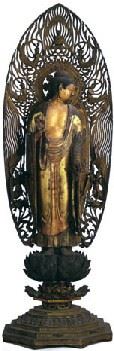
There are lots of paraphernalia associated with the butsudan... other than the central statue of the Buddha, rice offerings, candle-sticks and of course the incense sticks and Buddhist scriptures. Actually, it's not unusual to find food (including vegetables) being placed here overnight, an offering and yet something also to be consumed (perhaps extra tasty after a good period of blessing).

A small rin or bell/gong sits to the right (shown below)...these are sometimes known as singing bowls due to the fact that they (like bells) resonate when played along its surface with cylindrical hammer or mallet (I think they're called kon). These are often used in the practice of meditation and ancestor worship.

Okaasan had organised for a monk to come by for a special blessing. It's a strange combination to see the traditional buddhist aspects juxtaposed with L-kun's foam play mat. But the reality is that every part of T-chan's house in Japan is now L-kun's play area while we're there. Unfortunately, T-chan and I were going out so we didn't stay for the monk's visit (and I'm not sure it would have been so appropriate to be snapping away with my camera anyhow).

L-kun has always been interested in the butsdan, and often would sit by Okaasan when she prayed. I'm sure he doesn't understand exactly what's going on, but he knows that it's solemn, quiet and serious time. I think it's nice for L-kun to grow up with a broad spiritual base.

And here's just some more gratuitous photos of Okaasan's flower arrangements. She loves her flowers, and especially in Spring (although this was well into Summer by now), her front garden is always alive with colour of plants in bloom.

Wednesday, October 13, 2010

Kennin-ji... The Last (Sad) Hurrah


1st November, 2006 - Stepping from the Gion Odori, we had a feeling of joy and fulfillment. Could there have been any better way to end our trip to Kyōto? The answer was probably no. Still, we had one last opportunity to step back into Olde Kyōto on the way back to our apartment.

That temple was Kennin-ji, of the Rinzai Zen sect.


It's definitely not on the top 10 list of sights in Kyōto, however it was in fact the oldest (er... that means first) Zen temple to be established in Japan; initiated by the monk Eisai (Yousai) in 1202 AD. After returning to Japan in 1197, and having started teaching the way of the Zen, he was invited to establish a temple by the shogun Minamoto no Yoriie during the Kamakura period.

It’s emphasis on discipline was particularly attractive to the military thinking of the samurai of the Kamakura period. It was one of the few temples to have survived the Onin Wars (around 1477 AD), however was then all but destroyed in a separate uprising in 1556.
The Dharma Hall (Hattou)

 One thing that gets lost these days is just how young many of the founders of Japan were... Eisai was all of fourteen years of age when he was ordained a priest. When I was that young, I was largely worried about how to get through high school - and playing computer games...

The grounds are pleasant, but not necessarily impressive... one of the things that's a little interesting is the small dry garden (not shown) known as.... well...... huh? What ya talkin' about? Apparently this is the sort of crazy hijinx that Zen monks get up to (when not playing computer games)... the idea is that all forms in the world can apparently be constructed from these basic blocks. Actually... now that I think about it... if they only added an X, then we'd get a good advert for the Sony Playstation (maybe there's something in this computer game thing after all). This design was based on the untitled artwork of Zen artist, Sengai Gibon.

The temple itself is fairly enjoyable, but after two weeks of seeing some truly amazing temples and gardens I found it hard to get too excited... but if you're walking in the area, it's worth popping in and having a look around.
The Sanmon...The temple's main gate.


If you're in the area, and you've got the time (which we didn't) then pop in to see Hokan-ji, Yasaka's Pagoda, it's just a bit up the hill, and easy to see from many of the side streets.
Yasaka no To (Hokan-ji)

So, our last moments in Kyōto were spent, like much of it, walking through the streets of history. The Gion Odori may have been the cream-on-top of our trip so far, and like such feasts, what comes after can be a bit of a let down. And there was a feeling of sadness that had come into our hearts (end of holiday grief perhaps). Still, it had been a great (and busy) day - and we were leaving Kyōto - 12 days after arriving - with a rich memory of events, places, traditions and history that continues to bring us enjoyment through the years. It will also forever be linked to the pregnancy of our first son, L-kun.

If you haven't been to Japan before and you're wondering if its worth spending much time in Kyōto, then I hope that these posts have given you a bit of a feel for the sorts of things that you might experience (good and bad)... both the well trodden paths, and the more obscure sights (and sites). I know that many would wonder in disbelief as to why we would have spent so much time in Kyōto... and it's almost certainly not the sort of thing that most tourists coming to the city can even do. For me however, there remains so much more to see and do in this capital of "peace and tranquility".

I can't wait to return.
Posted by Picasa

Thursday, September 23, 2010

Eikan-dō? Yokan-dō?... In Zenren-ji, we all can do!


31st October, 2006 - As you walk down the Philosopher's Path, you will come across Eikan-dō on the left, across the canal. This temple was dedicated to a monk by the name of Eikan (1033 – 1111 AD) - actually his name was Yokan Risshi, famous for his evangelistic Amidism (a form of Buddhism).

The temple was originally known as Zenrin-ji (and still is), or "Temple in a Calm Grove" and was founded in 856 AD by Shinjō, a disciple of Kūkai and the Shingon school of Buddhism. It shows how belief systems evolve over time from the highly esoteric (ritualised and somewhat impractical) form of Shingon Buddhism to the popularist form of Jodo-Shu, otherwise known as the Pure Land Buddhism. The difference here is that Jodo-Shu believed that the recitation of the Nembutsu (the words Namu Amida Butsu) was a path to release from the wheel of worldly re-birth - to be born in the Western Paradise. This is a modification of the Chinese Pure Land belief where the Nembutsu (Nianfo) was only seen as a single part of the mediation ritual... rather than an ends in itself. Eikan didn't come to the temple until around 1072 AD.

Ok - this ends Japanese Buddhism 101. Let's have a look around the temple.

The Chokushi-mon gate to the temple proper is no longer in use, but makes for a nice backdrop to the sand sculpture which is immaculately raked every day.
The Chokushi-mon

The sculpture is simple in design, especially compared ot the patterns seen in Honen-in, and Ginkaku-ji.


Actually - when I look at Google Maps (satellite view) , I don't see much evidence of this "raked sand sculpture" area in front of the gate, and I wonder if this has disapeared since we were here in 2006. I'd appreciate some comments from people that have been here recently to update me.


The temple was enlarged by Eikan (i.e. Yokan), and he also built a large hospital complex for the poor and destitute, along with the means of producing medicines, within the temple grounds. The temple itself was largely destroyed around 1477 AD, and was later rebuilt in the 1500’s and then restored again in the 1880’s. It is now a very good vantage point to enjoy the autumn colours.... alas we arrived about 3 weeks too early to enjoy these.

Yokan (Eikan) reputedly repeated the Nembutsu 60,000 times a day... however just a simple calculation would suggest that if he managed to repeat the Nembutsu every second, it would still take nearly 17 hours a day of continuous recitation to achieve this huge figure. It could be that this was a story that transformed into this unbelievable figure... the offical Eikan-dō website suggests he did this many times, but not necessarily all in one day. I guess we shouldn't maths get in the way of a good story.


Towards the back of the temple there are several paths leading up into the mountain-side.

Here's a photo of an unsuspecting schmuck.... that would be...er... me, walking up the stairs known as the Garyuro. It would have been a much nicer photo if I hadn't got my ugly mug in it.

At the top of the stairs you will find the Kaizan-dō - where the three founders are seated (er... images of the three founders). You will also find one of the more interesting offeratory collections that I've seen here. You definitely can't doubt the honesty of most of the people that come here... Actually, I didn't notice this until now... but if you quickly scroll up and down past this image, it has a very disturbing (i.e. interesting effect)... or is it just my eyes?...Perspective, it's a wonderful thing.

If you go up another path you get to a pagoda... just above this shrine. However, we were starting to get a little tired and when we found out we had to go all the way to the bottom, and then all the way back up the top; well - let's just say we decided that somethings were best left for the next trip.

The legend goes that on February 15, 1082 AD, one of the statues in the temple stepped down and rebuked the praying Yokan (aka Eikan) for dawdling - such was his amazement at this unexpected event. A statue now exists (known as Mikaeri-Amida) to honour this occasion - and is indeed one of the highlights of this temple. The statue of Amida is noted for it’s unusual posture of looking backwards, as if to suggest (as it did to Yokan that we should follow the lead of the Amida Buddha - and get a move on about it. Personally, I think if I had seen a statue get down off its stand and start telling me off, one of two things might have happened. (1) I would have gone out to the nearest pub and got drunk, or went crazy, or both, or (2) it would have been on for young and old and by that I mean fisticuffs at dawn (statues should, by and large, remain statuesque and keep their opinions to themselves).

I didn't get a photo of it... but if you're interested, you can pop over (here) to have a look. It is a very famous statue.

Actually, now that I think about it, I'm not sure about this story... hold on... they built a statue to commemorate another statue coming to life? My vote would be for seeing the original "coming-to-life" statue. Come to think of it... might have been more trouble than it was worth. "Roll-up ladies and gentlemen (replace with culturally suitable invitation)... come see our amazing living statue... er... well, it was over there just a minute ago...has anyone seen where our statue went... er... anyone... nice statue...

The gardens of Eikan-dō are quite nice - and extensive. There's a series of inner gardens and larger outer gardens. The inner gardens are immersive, with the temple buildings floating above a quiet, serene and very green blanket.


The outer gardens are a little more brash. Perhaps a product of the golden leaves (yet to appear at this time). Certainly it's much more a stroll garden and can keep you occupied for some time.


Water plays an important part in the design and heart of this garden... as is often the case in Japanese temple gardens.

Now I'm starting to feel a bit like where's Wally (if you're Australian or English)... or Waldo if you're American... or Wōrī if you're Japanese. Needless to say, I don't think I'd last long in a hide-and-seek competition.
Bridge to Benten-shima - small island with shrine to Benten

The gardens surround the large Hojo-no-ike (Abott's pond), and must make for quite a sight during the height of the golden leaves weeks. We enjoyed the few trees that had started to turn early.


T-chan takes a stroll in the gardens of Zenrin-ji... Hey, not going to turn around for us?


Here's another great photo of T-chan... that's her on the left (on the bridge). How good are your eyes?


The temple is deceptive... it doesn't feel that big, but when you see it on a map (here) you get to appreciate just how big it is... big enough to run it's own kindergarten and library. Nowadays, it is golden leaves and living statues that dominate the visitors minds. It's easy to forget just how important temples have been in the fabric of Japanese society over the millenia - often forming the backbone of social support for the poorer communities. I have to admit, I often wonder if we haven't turned them into Buddhist theme parks... and I often wonder what the likes of Yokan (or is that Eikan) would think of it all...
Posted by Picasa