Showing posts with label Dance. Show all posts

Friday, December 16, 2011

Bon Odori - Dancing Through the Veil

14th August, 2010 - Every year, come the middle of August - at least in Hokkaido - something mysterious happens. It's known as Obon, one of the most important ritual festivals in Japan (outside New Years). It's traditionally associated with the return of the spirits of the departed to the world of the living for 3 days of the year (typically the 13th - 15th of the month, but more on that at the end). It's an important part of Japan, yet, I had not experienced it before... and was kind of curious. The original plan involved going to the city to see the Bon dancing in Odori Kouen, however, it was a big day, so we instead decided to have a look at one of the local dances in the neighbourhood. Disorganised as normal, we missed the start... just...


Now I'll give a quick description of the popularly believed Buddhist origins of Obon (as sourced from the Shingon Buddhist site). I say believed, as obon, like Christmas, is most likely an amalgam of different meanings. The day almost certainly takes its name from the Buddhist Urabon Sutra - which itself is a transliteration of the sanskrit Ullambana and which means to "hang upside down". This sutra tells a story of Mokuren Sonja, one of Sâkyamuni Buddha's disciples whom had supernatural powers (of course) which he used to find his deceased mother... only to discover that her soul had fallen into the world of Hungry Ghosts and was suffering immense pain. He then asked Sâkyamuni for guidance, to which he was told to make offerings to the priests coming back from their summer retreat. Which he did, with the result: - problem solved. [At this point in the story, I do pause and reflect on the commercial acumen of mystics back in those days... nice one Buddha!].


It's actually not that easy to find reliable info on the web [the irony of this statement does not escape me], but according to one of my books ("Japan: How We Breathe & How Our Hearts Beat"), obon's origins were in fact found from a much older seasonal tradition. Indeed New Year and Obon marked the transition between two halves of the calendar, and both involving ancestor worship and the offering of crops for thanks and for prayers. It was supposedly later that this was combined with urabon-e, and combined with the Chinese traditions of filial ties. Yet still, at it's heart there lies the tradition that like the Chinese Ghost Festival, or even Samhain (one origin of Halloween), for a short time the veil that separates the living from the dead is lifted. In this case, thankfully only for the spirits return home, to be honoured by their family. Indeed, obon remains a time when families return home from all over Japan to be together.

The dance, bon odori, originates as a welcome to the ancestors spirits, where the dancers would visit homes of people who had deceased during that year. I've also read that the dance may have originated from the buddhist monk, Kuya Shonin in the Heian period, but really the custom that we now know became popular in the Edo period... in fact was so popular and grew to such extravagance that the dance was officially banned between 1673-81 AD. 


The dance itself involves a large open space, in the middle of which is constructed a tower or yagura, upon which the musicians (and drummers in particular) are positioned. Around the yagura are a number of concentric circles, along which the participants dance. The dance is slow, rythmical and often based on local traditions... for example in Hokkaido, the fishing song Soran Bushi is apparently popular (though I can't recall it at this bon odori).

The following video is a bit of a grab-bag of the dance. Unfortunately the video is pretty crappy - apologies for that - but you get a bit of a sense of the music and the movements at our local bon odori. Actually, this was about the end of our videocamera, that just died in terms of it's autofocussing. Perhaps the spirits of the dead didn't appreciate my camera skills [insert spooky music here]...WOOOOoooooohhh.

It's a community event as much as a religious one... and indeed it's perhaps moved beyond religion to be just another thread in the fabric of Japanese life.  It's also a family occasion with lots of small children with the their parents. And indeed the first part of the evening is dedicated to them with fun and games (and even giveaways to the best child dancers). 


It's nice to see the yukata, or summer kimono, which is often worn out to special events such as this (and especially to fireworks for some reason).


Apart from the occasional yukata - worn predominantly by the very young and the very old - this was a fairly casual neighbourhood events. It's not quite to the standard that you will see in some areas, but I sort of think that's not important. Instead it's a occasion to bring community together - and I have to say that the dance itself is not unlike the mass-hypnotic dances that you might read about in tribal areas.. it is quite repetitive (in a good way) and quite rhythmical. The beat of the drum stirs something in your heart - even if your not Japanese.

I'm not sure if this is something new - but there was a fairly large emphasis also places on best costume-style awards. Not unlike a Halloween influence. And I have to admit that most of the theme costumes escaped me... for example the person that dressed up as what I think was a Stonehenge megalith. I'm not sure why, but they deserved a prize just for wearing that on such a hot night. And given that it's in the middle of a hot Japanese summer, there's always lots of beer being consumed. So it's quite a lively social event, at least in the neighbourhood. 

And of course - there were other strange costumes being worn. For example some gaijin fool and his child decided to dress up in their jinbei - a traditional summer clothing in Japan, but not the sort of thing you'd see someone wear down the street... let alone in front of hundreds of people. I'm sure most of the people were wondering what the... especially when the two of them started joining in the dance. Ah... what fools... But of course, that's me. And always the shy type, it took a lot of encouragement (yet surprisingly no amber courage) to get me up. Even though we stood out like sore thumbs (even amongst the megaliths) I didn't once feel out-of-place, and indeed I think the festive mood was just positive all around.

Now I have to admit something - until recently (about 5 mins ago) I had assumed that obon was celebrated at the same time everywhere in Japan, but when they switched from a lunar to a solar calendar (way back when...), the nation split on when to recongnize obon - with some areas having a July Bon (especially in Kanto region), others celebrating it in mid August, and even others maintaining the old lunar calendar timings. Supposedly, one of the reasons why obon was held in August was due to heavy farming workload in mid-July that didn't leave any time for preparation. It just goes to show that after many years of going to Japan, that you still can be surprised by things... and no matter how much you think you know, the country defies being defined by any one person.
As the evening wore on, there were less and less people, but as we left, I had the feeling that there was going to be dancing well into the night...

So - obon, and bon odori may not be the flashiest of events once you get into the neighbourhoods... but I suspect that this is where the true heart of bon odori lies. I'm not sure that the veil between worlds was lifted, or that our music and dance welcomed any spirits. It certainly awoke the spirits of those that danced though. And even to this day (over a year later) my son still sings the music (cha-cha cha chan-ko-chan...). And he's not the only one. 

Sunday, October 10, 2010

Gion Odori - Act 6 - The Final Frontier


1st November 2006 - By now you've perhaps had your fill of geisha and maiko....but (and this is coming from someone that was never a huge fan... even though he indulged in the traditional geisha stalking of Gion on a Friday evening) it was a good show, and one that I would recommend to all that are in Kyōto in early November. And now it was coming an end...

ACT SIX - VIEWS OF THE EAST (第六景 祇園東小唄)

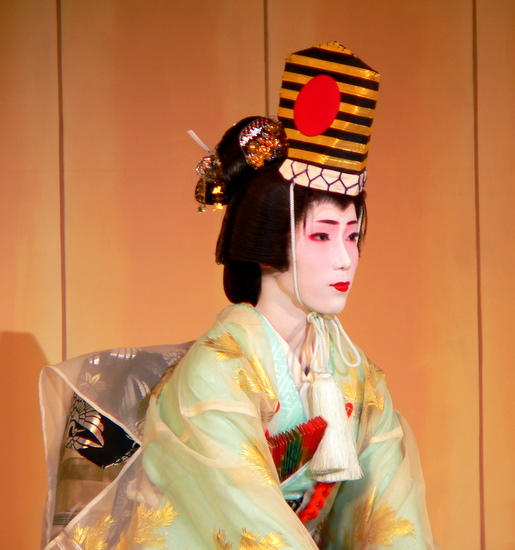
The sixth and final act begins with all of the performers now standing together for the first time. Maiko and geisha - and centre stage, the aged geisha who played the mischevious lady in Act Four.
The lights come up...


To the left are the five geisha, their kimono, make-up and hanakanzashi subdued and elegant...


To the right, the four maiko (sorry fourth one - out of shot), their outfits inspired by the colours of spring and autumn their makeup softer, lighter, and their hanakanzashi bright and beaming.


Time often stood still, as if it were captured on film...


Each moment in the dance is careful, deliberate, beautiful and yet distant. This is not an invitation to join with the world of the geisha...


But rather an opportunity to see that world, as through the looking glass... forever to be but a moment of stillness, before the exhalation of breath.


Who are these works of living art? A life-line of Japanese culture, or a dying anachronism? They might not share much with the world of most tourists that come to Japan (or indeed for the majority of Japanese themselves), but like golden leaves that tease the city streets and hills outside, they provide a colour and depth to the scenery that makes their absence so much more palpable.

And now for the last of the videos...once again - it can at best just give a sense of the dance. The one thing that I take from the video is that one shouldn't think of this dance as "synchronised" brilliance. Each geisha and maiko remain distinct...


I hope you have enjoyed my little photo-blog description of the Gion Odori... This was taken some time ago now - and of course every year is a different performance, but I hope that it has given you inspiration to attend one of the full performances. They aren't cheap (at 4000 yen per ticket with tea... but it's an experience you certainly will struggle to find anywhere else). There are a number of such performances throughout the year, so look around before you go to see when the nearest dance is scheduled.

Finally - I have to once thank my wife, T-chan, for her beautiful camera work... her steady hand and keen eye was our saviour. Now, as we stepped from the theatre, we knew that our time in Kyōto was coming to an end...
Posted by Picasa

Friday, October 8, 2010

Gion Odori : Act 4 and 5... Of Pride and Eating Flowers


1st Nov, 2006 - Well, I guess after my efforts describing the previous dance - which were just a little on the sarcastic side - I'll try and do this one a bit more justice. Though as you'll see it really is screaming out for the treatment as well.

ACT FOUR - TENGU  OF ATAGO (第四景  愛宕の天狗)

This dance is a little difficult to describe - however, I'll give a little history first. Tengu are mythical creatures that are a strange amalgm of human-shaped monster and bird. They are most famously depicted with red faces and long, long noses (check out the first photo above). The legend is that they are able to fly, and this has been  modified in some versions whereby they hold a magical hauchiwa, or fan made of feathers which have the properties of growing (and shrinking) the size of the nose... clearly a good ability for a Tengu... and also raising huge winds. I assume that flying is part of that as well.


Atago is a mountain near Kyōto, and is famous for a particular Tengu named Tarōbō - the first great Tengu. However, Atago is also believed to have a general concentration of Tengu, as it appears in many Japanese folk tales.

This dance focuses on one of the Tengu, proud and strong - and a rather crusty lady who has plans for that fan of his. Firstly Tengu espies what he thinks a young beautiful lady.

But not all is as it seems....


See the following short vid (once again, appologies about the quality).


In the end, the old lady makes use of the momentary disorientation (maybe even a change-the-pants moment) to do a now-ya-have-it-now-ya-don't trick with the Tengu's magical fan. Fooled again! I suppose there's a lesson here for the conceited and proud out there... don't try and pick up old ladies! To be honest, we can't remember the reason why the fan was so important, but at the end of the day - why let details get in the way of a good story.


ACT FIVE - MOTTENOHOKA (第五景  もってのほか)

The fifth dance of the show was the most abstract, and in many ways most beautiful... like moments come to life out of a painting. The entire dance was based around the Chrysanthemum flower. But here we have the mystery... mottenohoka means "out of the question"... and both T-chan and I now sit here and ponder... what the hell does that mean?....

The flower's supposedly known for the fact that it is edible... but alas, there was no flower eating during the show. Instead I will show you a series of photos taken during the dance (no video - and no story).


My only guess...if you could call it that... is that the dance surrounds the whole question of to eat, or not to eat the flower. The answer is... apparently... out of the question.

But how about eating a fan then?...

Looks like she'll just have to find some a Mister Donuts like the rest of us...

It was definitely the most artistic of the dances - with only the one solitary dancer - and the Chrysanthemum (and fan). I'm not sure now why we didn't take a video of it. Perhaps because this dance was so much more subdued than the others. Kinda regret it now... ?:-(

By the way - the Chrysanthemum is not only the Imperial symbol (aka the Chrysanthemum Throne) - but is also the symbolic gift for Mother's Day in my first home, Australia. What about elsewhere in the world?
Posted by Picasa

Tuesday, October 5, 2010

Gion Odori - Act 2 and 3 : Of Rice and Love


1st November, 2006 - This is the second post on the Gion Odori dance. By now things were in full swing, and it is hard to take photos when you're enjoying a show. Ever the dilemma - do you record for posterity, or just sit back and relax and take it all in. Still, we managed to take at least a few photos along the way. It should be noted that Gion Odori has, with the exception of the last dance, a different program each year. The one thing that is always written about the Gion Odori is the originality of the dance routines each year. Alas I have only one year to go by, but yes it felt original.


ACT 2 - OKOME (第二景 稲穂)
Okome is the Japanese term for uncooked rice. This whole performance is about the shinto rites blessing the growing of rice - of course rice is an important component of life in Japan (it's called gohan when it's cooked, which is also synonymous with the more general word for meal). This is a dance celebrating early spring.

There was a directness, and seriousness that really made for an interesting dance here. It's not the first thing I would have thought of when thinking "Geisha dances".


I have to admit that I get a little confused here... as the theme is all about hanakanzahsi... but the main ornament here appears to be the shinto inspired boushi. From what I understand, thanks to Melissa Chasse's great work is that maiko wear stalks of rice in their hair at the beginning of the year.

Hmmm did I mention the "double trouble" aspect of it. Synchronised shinto. Now why hasn't that taken on?

Actually when I first saw this, I had assumed that the stray locks were just coincidental... it wasn't until I had seen both in the photos that I realised that it was intentional. Actually, it was most probably better when it wasn't part of the costume design.


ACT THREE - SHIDAREZAKURA (第三景 撓垂桜)

This was a somewhat melancholy piece - with the name coming from the weeping sakura tree (or cherry tree... though they don't have anything to do with cherries that we eat, though they come from the same prunus genus... ok too botanical I know). It's the story of an older woman (hmm - I bet casting for that was a joy) waiting her lover...

Waiting... waiting.... man'o'man! I'm sure I left him somewhere around here...now what did he look like?...

Hmm.... shouldn't have had that extra 10 gyoza for dinner....

Errr... that last bottle of sake isn't going down too well either....

Ah... I know.. a little light reading will help... a letter from my lover. That will give me time for the alka-seltzer to kick in. For crying out loud this guy can write... blah blah blah...

Seriously, my arms are getting tired... you mean I have to wait hundreds of years before Twitter will come to my rescue with a 140 character limit!... now where was I?... that's right... "your eyes shine with the moon's soft remembered light, in the dark your smile a memory o light... oh, and could ya please buy some milk and bread on your way home, and did I mention the guys were thinking of having a night out this Saturday....."

At times like these - a sister needs her sister. Younger sister that is. "Sis... hold this will ya... ?"

"Did he say he was going out this saturday... I told him we had plans for this Saturday...oh, he's going to pay... big time" Even in olden times revenge was a dish served cold. Unless of course it was a dish of firey stick-it-up-ya-... well you know...

It's times like these that an elder sister needs to impart some sage advice. "Next time... bring your own lamp...".  Ah, it truly left me warm inside.

Alas... the lot of a younger sister is to forever suffer the slings and arrows of her big sister... "It's most probably a good thing that I didn't mention the other night when I bumped into her boyfriend at the club...."

Ok... I might not have gotten my interpretation exactly right... but I'm pretty sure it's captured the essence of the dance. For more info... check out the bad video below.


And by the way... if I haven't mentioned it before... I have to thank my wife T-chan for taking such wonderful photos... my hands are too crazy shaky to take decent photos in this light. Thanks T-chan... I luvs ya! PS... could you please buy some parmesan on your way home from Zumba tonight....

Posted by Picasa