Showing posts with label Things to Do. Show all posts

Wednesday, July 18, 2012

Minato Mirai 21 - The Future Is Now

18th August, 2010 - After a long, hot day in at Chinatown and then the Anpanman Museum, we walked over to one of our other favourite places in Yokohama. Minato Mirai 21, a typically Japanese entertainment district / business district / port facility that was developed out of land reclamation of Yokohama harbour. Actually the idea came out of the heady 1960's, when the future of Japan beckoned... but had to wait till the 80's when Japan's finances and near-orgasmic-desire-to-build knew no bounds. And thus, out of the sea was born a concrete and steel vista of grand proportions.

The tourist guide has a lot of information on Minato Mirai 21 here, and there's a lot to see and do (more so than we had time after a very busy day). 

View Tokyo Map in a larger map

Still, it was surprising just how rejuvenating it was for the sun to start setting... and as we approached Minato Mirai, the air cooled (not by much), and yet, the streets became strangely quiet. This part of MM21 is much more business oriented I guess, and by 6:30pm the streets were not quite a ghost town, but by Japanese standards it was pretty close.


Our first stop was World Porters, a large shopping complex on the "island" part of MM.... unfortunately no photos, so Google StreetView has come to the rescue. World Porters has a pretty extensive food court available, and is worth popping (along with the much larger Queens Square Towers).

Care of Google StreetView

Food court's are pretty well the same all over... the only thing that changes is the cost, the crowds and the cuisine (ok... that sort of means that every food court is different).

And if you're interested in what sort of prices food court meals are in Japan... well here you're looking at somewhere between 600 and 800 ¥ - in Aussie Dollars that would be approx AUD $7.50  - $10 based on today's rate (about 80 ¥ for each AUD).... drinks separate. 


Well, there was a pretty good selection here, though we went for something traditional. Steak! That's right people, not all Japanese food is the same. Then again, even a dishes like steak tend to take on a different, asiatic, flavour as you might expect.... and the verdict. Well, coming from Australia, where we like our steak big, thick and juicy, it was... ok.

Next stop was Cosmo World, a small amusement park that sports a couple of smallish roller coasters...
It's nice to see Australia front and centre!

 ...and one BIG Ferris Wheel... oddly named the Cosmo Clock.

From this angle it might seem slightly less odd... but for such a big Ferris Wheel (measuring around 100m) you'd think that putting a relatively small clock would not a HUGE clock make).

And some more gratuitous night shots...

L-kun was still a little tired after his long day...


Now, speaking of BIG... one of Yokohama's popular attractions is the Landmark Tower, which stands approximately 296m in height and is currently (at writing) Japan's tallest building and 3rd tallest structure. That's pretty impressive, given that Japan's constant earthquakes have tended to limit the construction of the super-skyscrapers that have developed around the world (in fact, this is only the 80th or so tallest building in the world today). There's a very good observation deck, known as the Sky Garden, on the 69th floor - and 273m high. This is reached through the fastest elevator in Japan... all designed to get you to the 360 degree panorama as fast as possible. That and to quickly unload you of the ¥1000 per adult (between ¥200 and ¥800 for children depending on the age). As we arrived here very late, we decided to give the Sky Garden a miss this trip.


When there's so many other places to visit - like the Ice World attraction, where you too can experience -30 degree temperatures, all whilst it's a hot sweltering 37degrees (with about 80% humidity) outside. With a wife coming from Sapporo, this was not something that we felt a great desire to experience.


One of the attractions that did interest however was this glorious Carousel as part of the even smaller amusement park, known as the Kids Carnival Zone. It actually astounded me that in the middle of a hot Japanese summer (one of the hottest on record back in 2010) that at 8:30pm, there was almost not a soul to be seen around MM21. I'm not sure if this was a sign of the economy, the weather or just the fickle Japanese punter, but for us it was a great night to be out and about. Even as tired as we were, hot summer nights can be fun. And this carousel captivated me, and my camera.


With such an inviting stairway, who could resist taking a ride?


But there were other things to do... a chat with Anpanman and Doraemon (two of L-kun's favourite Japanese children's anime characters)...


Or perhaps ride on a Baikinman (also a character from Anpanman) car... let's just say that this was one Japanese roadway that wasn't congested. At all.


Just down from the Carnival Zone, there's also a beautiful old four-master, the Nippon Maru, permanently moored in Yokohama harbour as a museum. The ship was made in the 1930's as part of Japan's merchant seaman training program. Eventually it was replaced in the mid 80's and since then has been gracefully educating us land-lubbers. Unfortunately opening hours are 10:00am to 5:00pm - so we'll have to take a rain-check on that as well (¥600 per person for high-school students and above, or ¥300 for younger students).


Heading back towards the Landmark Tower we came across a great little ampitheatre that was the home of some very funny and enjoyable street-performers... definitely worth checking out for some 'free' entertainment, but I'm not sure how regular it is. Right next to the ampitheatre is a wonderful modern sculpture known as the "Moku-Moku Waku-Waku Yokohama Yo-Yo" designed by Hisayuki Mogami in 1994. It, along with the Landmark Tower, is a symbol of the Minato Mirai 21 - which was actually a popularly voted name that means the roughly the Future Port of the 21[st century]. MM21 is a modern development and there's much to like about it... but the name also tells you something more... this is, after all, a working port. As we walked around, it certainly felt more like a business district than a life-centre. But perhaps we saw it on a bad night (it was a Wednesday after all).


So as we made our way back to the train station in the Queens Square Tower complex, it was interesting to reflect on our first full day in Tokyo this trip. It was an amazing day - but also exhausting. As we travelled down one of the longest escalators I've been on (and not that enjoyable for someone who doesn't like heights), I looked up to see a happy care-free Snoopy floating past, suspended mid-stride. There are many things that inspire in Japan, and also things that defy explanation. Japan is an amazing country however, filled with many different possible experiences all able to be enjoyed in a single day. Yokohama is one such place, a short train-ride out of Tokyo (though you may not realise that it's a separate city) that is well worth visiting if you've got a spare day - or night. 


Like many places in Japan, built on the promise of an the inexhaustible Future (during the hey-day of Japan's prosperity) there is a sense of modern exuberance and flamboyance... but as the Future collides with the Now in these places (such as MM21 and Odaiba in Tokyo), you realise that Japan is as much a contradiction in perspective as culture. It was the dream of a cleaner, brighter, taller and stronger tomorrow that drove it to build... but one also can imagine that sometimes, just sometimes, people were not always the most important (or even necessary) in that vision of the future... and then again, sometimes that vision needs to be re-interpreted to meet the needs of an increasingly changing Japan.

Friday, June 22, 2012

Anpanman Museum... It's Not Easy Being Edible

18th August, 2010 - Yokohama's Anpanman Children's Museum and Hall....or perhaps known better as just the Apanman Museum. Now first things first, I suppose I should tell you a little about who Anpanman is, and why the hell he'd have his own museum (let alone, why are we visiting it). 

Anpanman is (if you hadn't guessed it by now) a Japanese children's character that started life back ... well... let's just say he's only slightly younger than myself (only slightly).... anyhow he started life as a picture book and then around 1988 transitioned to the world of moving pictures. And of course, merchandising. But it all started with a funny looking character with a bun for a noggin... not just any bun, but an anpan (which is a small bun filled with anko, which is made by sweet red azuki beans). And indeed, such is the popularity of Anpanman, that he's been shown on tv continuously since it's start. Not bad for a smiling bun boy.


Now... Yokonhama is also where you'll find the Anpanman Museum... though you might not find that high on the list of places you must see in most guide books. For good reason too. Anpanman is a distinctly Japanese phenomenon and they don't really care if he translates across to a broader market or not. Indeed they don't bother even providing non-Japanese information on the web-site. Now having said all of that, if you wanted to experience something very Japanese with your young children, then perhaps it's not a bad idea at all (just prepared to go along with the experience).Now the museum itself is perhaps poorly named... it's half free shopping centre (where you can buy any number of Anpnanman related paraphenalia) or there's the mini theme-park (that's where you're coughing up 1000 ¥ per person... for three floors of fun and games). The first section has a number of diorama's depicting all number of stories... some of which are "animated"....


Because it was bon odori time there was of course a special bon odori scene as well... and we'll return to this a bit later.

But without doubt, it's all about Anpanman... and L-kun was a pretty big Anpanman fan!


But it wasn't just Anpanman... oh no... there was a cast of thousands of characters. Ok... not 1000's, but a Guinness World Record of 768 unique characters....

Of all sorts and sizes... well lets face it, when you've hit 700 the remaining 70 odd must be a real killer to find something to have a character based on .... hey look, it's mister inanimate-rod!

But whilst they go to extremes here, it's nice to see so many different characters of different styles... and as I said, it's distinctly Japanese.... after all, where else would you find Onigiri-man (onigiri = rice ball).

And death never looked so good... ok. no, it's not death catching a ride, but rather Horrorman (yes, that's right). The orange (uni-horned) character is Dokin-chan... his partner in crime. We'll meet their leader in mayhem, Baikin-man later.


Now... it's nice to show this sort of photo. A happy smiling child always makes you feel good. Unfortunately, it had been a long, hot day... and L-kun had also reached the end of his energy (sweated out most likely), so he didn't quite get into it as much as he perhaps wanted to.


But there were lots of things to do... all of course having a very Anpanman slant to them... but the good thing about the museum is that there's always something just around the corner for them to explore in/on/around.


 There's also an open play area where parents and kids can get some rest, or regenerate some energy for the next onslaught (and of course, they can also watch streaming Anpanman videos as well).

There's also craft sessions, where children and parents get to make some of the characters (in this case, Dokin-chan).

And there's also a number of "rides" that children can enjoy (with a little imagination)... looking out...

And looking in...


Though I'm not sure he was taken with the artwork.... everyone's a critic.

Whilst there were a few hands-on activities to keep L-kun busy, he did manage to perk up when we reached the bottom floor with the slides. He's a simple boy at heart.

There are a number of live shows semi-regularly throughout the day in a large auditorium... this one was MC'd by Melonpanna-chan, Anpanman's close friend (and some might say love interest?....)

We awaited the start of the show with much expectation...


Melonpanna has some support from a very enthusiastic staff... and she knew just how to get the children to near exploding point in anticipation of the big man himself....

Anpanman! Oh yeah baby.... work that room. And did he ever... which was good, because otherwise he may have had to resort to his secret weapon. When friends are in need of help, or just hungry, Anpanman will offer his head to be eaten... and I mean, not just a nibble, but a full-on feast. Now that's a friend that gives that little bit extra. It's ok however, as his father Jam Ojisan will often bake him a new head. I sometimes wish I could get a new head baked...

The show itself is largely singing and dancing to an Anpanman theme song - and whilst there wasn't much story involved, the children seemed to love it. Once again, don't expect to have much of an idea of what's going on if you don't know Japanese and aren't familiar with the show.

As mentioned earlier... given that it was bon odori time, there was a special focus to the events... including an impromptu taiko performance. I have to admire the people inside these suits... it was still boiling hot (and I mean boiling), and yet they were running around and having a great time.


I also haven't introduced perhaps the second biggest character in the show... it's Baikin-man, where baikin stands for bacteria.... and Baikin-man is the lord of all germs, and hence Anpanman's arch-nemesis (though there's also a strange friendship there at times as well - perhaps as they represent both sides of the same coin). He's cheeky, clever, and oh so naughty - perhaps why he's so popular with children (and our son).

And of course, it wouldn't be an Anpanman Museum without a whole heap of merchandising opportunities available to you. And I mean lot.

One of the more interesting aspects is the bakery... I mean, isn't there something a little disturbing about eating a Shokupanman (shoku pan = white bread, and he's one of Anpanman's closest friends). He's also very tasty. Damn you Jam Ojisan (on the right below)... why did you create your world of delectable super-heroes?

Overall... it was a long day (and not over yet), and whilst I felt that the museum was a little over-priced for what you got (especially considering the merchandising), and perhaps not the best place to go on a hot day, it was interesting to visit anyhow. And L-kun enjoyed too, in between his heat-exhaustion - and still talks about it to this day.

And did I say there were lots of characters?.... let's just say, there's enough to keep birthdays, Christmases and just about every other Sunday occupied with new presents....
(top left to right: Jam Ojisan, Baikin-man, Tendon-man, Anpanman, Omusubi-man;
bottom left to right: Cheese, Dokin-chan, Shokupan-man, Melonpanna-chan, Curry-panman, Kamadoman)


Info:

4-3-1, Minato Mirai, Nishi-ku, Yokohama, 220-0012
Tel: 045-227-8855
Open : 10:00 -18:00
Cost : 1000 ¥ per person (over 1 year old) 

How to get there: The easiest way is by taking the Minatomirai / Chinatown Line from Yokohama Station, catch the  (180yen) getting off at Shintakashima Station 新高島駅 and then walking about 550 m (7 mins) to the south.


Sunday, April 29, 2012

Gate-Crashing Yokohama...When Is Wednesday Also A Mon-Day?


Chinatown is approached through a number of gates, or mon in Japanese (門), in traditionally flamboyant style... though they can be slightly odd, sitting in amongst the normal traffic signs. There are 10 gates all up in Chinatown, arranged according to the Chinese art of Feng Shui - bascially a throwback to the ancient beliefs relating to superstition to shape, structure and colour. The first four are the most important, relating to the Four Symbols in the Chinese Constellation. Whilst it was my intent to take snaps of them all, the reality was that the oppressive heat beat me. So here's just a few of the shots that I did manage to take before heat exhaustion threatened to get to me. I've also made use of Google StreetView to help with the rest... it's kinda cheating, but... I've also made use of the info on the official Chinatown website - though unfortunately this part is in Japanese only.

I've made up the map below so you can reference the gates by numbers (in no particularly meaningful order):
Map care of Google Maps.

1. The East (東) Gate or  Chouyou-mon (朝陽門). This gate relates to the Azure Dragon God, and brings prosperity. The Azure Dragon is said to relate to the East, and Spring - and is associated with the wood element. It was only opened in 2003, and is the largest of the gates.

1. Chouyou-mon

2. South (南) or Suzaku-mon (朱雀門). This gate is associated with the God Suzaku - the Vermillion Bird - and hence the colour red. It relates the generation of good fortune from disaster, and is also related to the fire element, the direction South, and the season Summer.

2. The Suzuka Gate (source: Google StreetView)


3. The North (北) Gate or Genbumon (玄武門). This gate relates to the Black Tortoise, and is associated with the God Xuanwu (in Chinese) or Genbu (in Japanese). The gate is linked both to the North and to the season of Winter.
3. Genbu-mon (source: Google StreetView)
4. The West (西) Gate or Enpei-mon (延平門). This gate is related to the White Tiger God of Chinese astrology, and is known by Baihu (in Chinese) or Byakko (in Japanese). Actually the White Tiger (the West Gate) and the Azure Dragon (the East Gate) were said to be brothers, and reincarnated as two ancient Chinese generals. It represents the direction of West, the colour white and the season Autumn. The gate relates to eternal peace, as the legend goes, the tiger's tale turns white at the age of 500, and only appears when peace exists across the world.
4.  The Enpei-mon (source: Google StreetView)
5. The Prayer for Good-Neighbourly Gate (平和を願う善隣門) or Zenrin-mon. This gate was originally constructed in 1955 when the area was known as Nanjing Town. It was later re-signed as Chinatown, and renovated in 1989. It is perhaps the symbol gate for all of Chinatown now.
5. Zenrin-mon

6. The Chikyumon or Earth Gate (地久門). This is the first of the pairs of gates that stand at the Western and Eastern ends of Kanteirou dōri , which are basically representing Heaven and Earth (or... should that be Earth and Heaven). There are two important areas that can be accessed from this road, but I'll talk about them in subsequent posts. The matching gate is gate 7.
6. Chikyumon
7.  The Tenchoumon or Heaven Gate (天長門). The second and Eastern of the two gates.


8. and 9. The Market Street Gate or Ichibadōrimon (市場通り門). This is the second of the pairs of gates, and can be found, not surprisingly, on Ichibadōri. It may not quite look like it today, but this street is normally a thriving centre of activity. I'll explain why that wasn't the case in the next post...
8. Ichibadōrimon (1)

9. Ichibadōrimon (2)

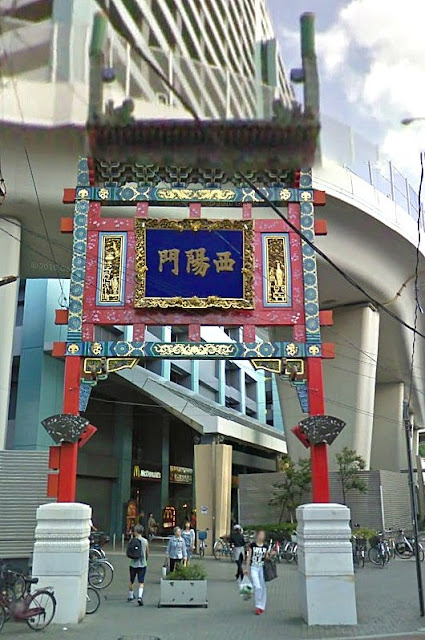
10. The Seiyō or Closest to the Western Sun Gate (西陽門). This gate is named so as it's supposedly closest to the Suns light on the Western side. Hmmm - looking at the map on Google, I'm not entirely sure about that. To be honest, it's also a very strange place to have a gate, snuggled as it is right next to an over-pass.
10. Seiyō Gate (source: Google StreetView)

Looking back at the Eastern Gate, there's a lot of detail in their construction - as is the wont for Chinese gates. There's a lot of work in these things, and I do wonder if it's a specific set of skilled artisans that go around the country (or the world) making Chinese gates. A little note of explanation. Each of the gates have two signs... the outer side (see the first image above) says Chinatown, the inner side gives the gates name. Below is the sign for the Chouyon-mon or  朝陽門 ... in Chinese characters, this is read, right to left...門陽朝..


Whilst the light was not the best for photographing (hmmm... this was clearly before I started playing around with HDR photography), I love the complete crazy psychedelic colours in the Chinese (Japanese) architecture... I can just imagine what it would have been like back in the day, being a paint salesman in ye olde Japan


Subtlety was not one of their strong points, I fear....


I'm not sure how long the gate took to complete, but it's certainly an amazing work or art, and a grand way to welcome anyone into Yokohama's Chinatown. Whilst. I'm not sure if gate-spotting as a hobby will catch on, but it is fun to explore the whole of Chinatown to see them all. Although I've still got 4 to find on one of our next trips.