 3rd February, 2003
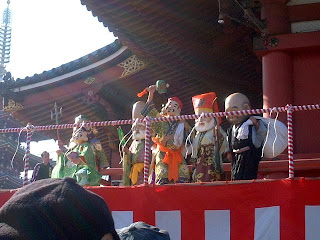
 - There are two further interesting things about Setsubun at Senso-ji. The first is that following the arrival of the "years men" on to the sage surrounding the temple, there is a sudden arrival of the Seven Lucky Gods (
Shichi Fukujin) who include (not in order):
Hotei (god of happiness and health)
Jurōjin (god of longevity)
Fukurokuju (god of wealth)
Biashamonten (god of warriors)
Benzaiten (goddess of art, knowledge and beauty)
Daikokuten (god of wealth and trade)
Ebisu (god of fishers and merchants)
Don't ask me why they're there... as far as I know this has nothing to do with Setsubun. What does have a lot to do with the festival is the ceremony called Mamemaki, or bean throwing. Yes - you guessed it... it involves the throwing of beans. Lots of beans. Indeed, the gods and the assembled men pelt the surrounding crowd with soy beans, which are dutifully caught (or lodged in various body parts). The purpose of catching is that you're supposed to eat the number of beans equalling your age.
In households, generally the male head of the household (adorned with demon, or
oni, mask) would be chased around and attacked with soy beans whilst shouting "
Oni wa soto, fuku wa uchi" - Oni go outside, good luck come into our house... or something like that. After having had his fill of abuse, the
oni would leave the house, and take his bad luck with him.
Note: In at least Sapporo, the soy beans are replaced by red azuki beans.


 3rd February, 2003 - Senso-ji in Asakusa apparently started life when two fishermen fished out a golden statue of the Kannon (see later blogs) from the nearby Sumidagawa. Smells a bit fishy to me... Anyhow - the current temple complex is very new, dating from the 1950s. By the way - the Kannon statue is not on display. By this time we were still collecting our beans, and there were a million and a half (ok - slight exaggeration) people walking around.

 3rd February, 2003 - There are two further interesting things about Setsubun at Senso-ji. The first is that following the arrival of the "years men" on to the sage surrounding the temple, there is a sudden arrival of the Seven Lucky Gods (Shichi Fukujin) who include (not in order):
 3rd February, 2003 - One of the components of Setsubun at Senso-ji is the procession of men of that year (based on the 12 year cycle) that take their lanterns along the final path to the temple itself. Don't worry if you miss this - it gets repeated every couple of hours from memory.
 3rd February, 2003 - Today is Setsubun, a traditional day in the Japanese calendar... it's supposedly meant to divide seasons, but the 3rd Feb is the traditional day that is observed. It's also known for the bean throwing... but more on that later. We came to Asakusa, an older district in Tokyo, to see Setsubun at Senso-ji (a large ancient Buddhist temple). The first temple was reportedly built around 645 AD, and as such was the oldest in Tokyo. Buddhism came to Japan from China around the mid sixth century, an flourished there.


