Showing posts with label Home Life. Show all posts

Sunday, September 18, 2011

Sudako and Temaki Zushi... Why I Gain Weight in Japan - Again

9th August, 2010 - Well I was in for a treat again tonight. Two dishes. Sudako and Temaki zushi - or simply put, hand-rolled sushi. I'll start off with some gratuitous entree diversion known as "sudako", or pickled octopus. First off - get yourself an octopus... then it's pickled in Japanese rice vinegar, sugar, and most likely a good helping of MSG (yes folks, it's not just chinese food that loads up on the good ol' monosodium glutamate). Still - I'd be more interested in knowing how they manage to get this colour!

Slice and dice said octopus (purchased already pickled). Hmmmmmmmm.... tentalicious! This isn't necessarily for the temaki zushi, but it's a great side dish. Any time. Of course - this is not raw... and it's not just eaten by itself.

Instead, it's nicely served up with a big old dollop of Japanese mayonnaise, soy sauce and shichimi spice, or seven flavoured chilli spice. The octopus is simply picked up an dipped into the mayo. Simple and stupendously yum. Who said great food has to be complicated?

Now most people when they hear sushi, their thoughts turn to the small shop-bought sushi from their local (healthy eating fast food). Alternatively, there's the image of the crusty chef who's been perfecting the art of making sushi for decades and whose sushi melts in the mouth. Finally there's those of us foolhardy enough to go and buy a sushi rolling kit and try and do it ourselves. The results of these attempts are normally fraught with stress at getting a decent looking sushi roll.

Now here's the thing...We finally come across (possibly - surprisingly - for the first time in my blog) Nattō. Yes. Nattō. Doesn't sound too bad, does it? Looks kinda like baked beans... but trust me, if computer technology had advanced enough to communicate sheer ickiness, then you'd get the right impression. Nattō is a fermented soy bean... or as we call it, rotten beans. It comes with it's own bacterial growth for crying out loud (Bacillus Subtilis... which by the way, apart from generating rotten beans, can do interesting things such as decompose some forms of explosives. Even I have to admit that's pretty cool) . Nattō 's pungent, highly sticky (and stringy) and has a very sharp nutty flavour. The Japanese love it, and I guess it's one of the reasons they are Japanese after all. So this ingredient is for T-chan and her family. I regret to say, that L-kun loves it as well. 

Now you can't have temaki zushi without some nori... seaweed sheets. Love it. This is just cut into quarters, perhaps about 10 cm square (or slightly larger).

The secret of making sushi rice is vinegar... and Japanese rice vinegar in particular. You can buy sushi powder as well (to provide a more authentic flavour - and which is a common additive in Japanese homes) - or failing that you can make your own extra flavouring by adding sugar and salt to the vinegar. A simple recipe is: for 3 cups of rice you will need to add 1/2 cup of vinegar, 2 tbsp of sugar and 1/2 tsp of salt. Mix the vinegar, sugar and salt, and then gradually and gently paddle the mix into the cooked rice. Add to taste - and be careful not to add too much vinegar. T-chan's parents do it the easy way with sushi rice powder.

It's also good to add in some prawn or ebi. Ebi are one of L-kun's favourite foods, and it's usually the first thing that he'll look for or ask for.

Now for the main ingredients for the sushi. We simply use raw tuna (maguro), salmon (sake), mackerel (saba), cucumber, salmon roe (ikura) - or as we did this night, you can use something like flying fish roe (tobiko), cooked egg roll cut into strips - and of course, freshly cooked rice. Don't forget, you're the chef so you can put in whatever you want. There's few if any rules, other than what can be comfortably held in a roll.

So here comes the part where you'll think - hmm, I think I could do that. No need to roll anything... just put your nori flat in your hand (or on the table) and then grab a rice spatula and push the rice onto it. Then simply pile up whatever ingredients you want... ok, including the Nattō, and then when you're done, just grab one corner around (as you would if you were making an icecream cone).

And yes, you can most probably roll them better than this... but don't forget, this is for preparing and eating at the same time. The thing to concentrate on is that you don't want your ingredients falling all over the table. You don't need to get hung up on the perfect conical roll. Not unless you're preparing them earlier or inviting over the Queen. That's one reason why we never buy temaki zushi when going to a restaurant... for us, the fun is in the making!

 Bon appétit, and itadakimasu

Friday, September 9, 2011

Drinks Anyone - Japanese Drink Vending Machines

8th August, 2010 -  It's time's like that you need a nice cold refreshing Coca Cola... (advertising commission is in the mail, I'm sure). Well, this is just a short post about another typical part of Japanese life. Vending machines. Especially drink vending machines. You can tell this photo was taken in summer as all of the drinks are cold (blue lights). One of the best part of Japanese vending machines are the hot (er - red light?) drinks. A great winter's treat to grab yourself a hot can of coffee from a vending machine as you're negotiating the snow outside. That's a long way away now however.

I'm constantly amazed how these vending machines are not vandalised.  Then again, there's very little apparent vandalism or graffiti in Japan in general. I'm also curious about just how ubiquitous these vending machines are. They're everywhere - in fact there's one sitting on the street about 50 m from T-chan's house in Sapporo. In the middle of nowhere. I can't even say I've ever seen anyone buy a drink from it, so I wonder why it's there. If nothing else, I suppose it's a tempting advertising method...

One of the other differences you can notice is the range of drinks: coffees (lots of different styles), teas, coke, sports drink, green teas, fruit juices (still or carbonated), and of course water. And all pretty cheap (from 120yen for the smaller drinks to about 150yen for the larger). And did I mention the beer vending machines? Hmmmm.... beer vending machines... it's a hard life.

Saturday, September 3, 2011

Sapporo At Night With Cars and Camera

8th August, 2010 - I went out for the evening, and took my camera along. The night was still quite hot, and for some reason I was attracted to the bright lights of the food places. Lots of food places. The Japanese tend to spend a lot of time eating away from home.

Anyway - where was I - that's right. Eating out. Well, of course that's a really bad segue to the photos of cars parked out the front of eateries. Not the most amazing photos, I know, and they had more to do with me seeing what my new camera would do than anything else. But it does allow me to talk about cars. Well, the one thing about car ownership in Japan is that it's actually quite cheap - certainly compared to the cost of buying a car here in Australia (Note - with the current high Aussie dollar, that's getting better). There are two exceptions to this - getting a drivers licence is hugely expensive for Japanese, and the life-time of cars is ridiculously short.

Japanese have to attend a driving school as a prerequisite of getting a licence, and this can be quite an expensive exercise (I've heard of fees exceeding 300,000yen). Amazingly expensive. Then of course there's always the tests. The written test sounds like it's just a formality (10 multiple choice questions), but the driving test is where it gets serious. From all accounts, it's common to take 2, 3 or 4 tests before passing - of course paying a fee each time. Of course, if you're a foreigner you can drive on an international licence for up to a year. You can "exchange" your normal licence - and if you come from Australia, UK, Canada, New Zealand or most of the European countries you can even avoid the written and driving tests. Sweet. If you're unlucky not to have lived in any of these countries, then sorry, you've got a more painful process to go through. There's some more info about the process - at least in Sapporo to be found here, and a couple more here and here (this is a good one).

The thing about cars in Japan is (apart from them tending to be quite boxy IMO) they tend to be relatively new. New cars are comparatively cheap, but second hand cars are VERY cheap. The reason is that as cars get older in Japan, they become harder/more expensive to register. They have to undergo regular (every  2 years) road fitness tests (called  Shaken) which gets stricter the older the car. That's why many people tend to off-load their cars once they get to around 60,000 km. And don't expect to get much when selling an older car... it's more likely you'll have to pay to get it scrapped/recycled. Coming from an Aussie experience, this is a very strange system. It does however have the advantage of ensuring much cleaner, cheaper, and safer cars. Of course, it also keeps the auto-industry cruising along very nicely, thank you.

By the way - you may notice in Japan that there are different coloured number-plates - yellow plates indicates a smaller category car (for commuting around town), and white plates which indicate larger (more expensive) cars. Costs for things invariably depend on whether it's a yellow or white plated car.

Just quickly - the other thing about driving in Japan - or at least Hokkaido - is that (1) speed restrictions seem to be not even a suggestion - most people seem to drive 20km/hr over here, (2) radar detectors are almost universal (hence point number 1), (3) people hardly ever parallel park - perhaps for efficiency, (4) when perpendicular parking it seems many more reverse as compared to front-first (which is more typical here in Australia), and finally (5) the exception to number 1 is that if you come across a police car, no one seems to dare to pass that police car - on even multiple lane roads - no matter how slow it's driving. This last point can be very frustrating!

In retrospect, I'm not exactly sure that this was such a good idea to be standing outside taking photos of people's cars. I suspect there may have been at least a few people thinking "What the hell is that silly gaijin doing taking photos of our cars. Let's go punch him in the head... after we finish this wonderful dinner... if he sticks around.... for another 20-30 minutes more."  Ok. That's a very un-Japanese way to think. But people should be a little careful to respect the privacy of others - and whilst being a foreigner in Japan does tend to lend you a lot of licence to do "strange things", it's not a right. 

Saturday, June 25, 2011

Sweet Decoration - A Shopping Paradise

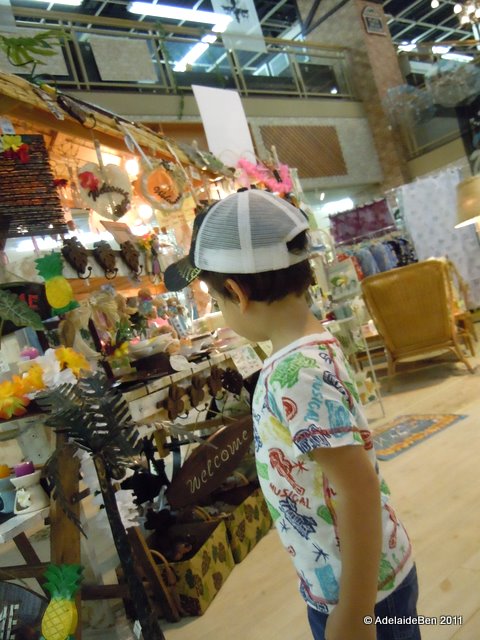
4th August, 2010 - One of our typical days out when we go back to Japan is invariably.... shopping. Shopping for the house, that is. Japan is most definitely a consumer's paradise for many things... and house products is one of those things. And one of the best places we've found for cute or interesting goods is known as Sweet Decoration (Japanese site only)... and the one we went to today is around Nishiku district.


The company first started in 1950 in Obihiro in Hokkaido, and whilst it's expanded to 12-15 different stores they remain a Hokkaido specific company - though they're now expanding into all sorts of commercial areas, including insurance. So appologies if you're reading this outside of Hokkaido. The good thing about these big stores is that they are largely one-stop-shops in terms of house interiors... including furniture, rugs and carpets, curtains and bedding...

It's times like these that we wish that we could buy lots of stuff and transport back home (actually, I am pretty sure that T-chan's real desire is to buy lots of stuff, and move back to Sapporo!). And the furniture doesn't cost that much either. I have to say that it's very reminiscent of walking through an Ikea store, as most of the furniture is designed for small spaces. It's always funny to see Japanese sized kitchen tables and chairs (it always feels like I've suddenly appeared in Hobbit-land where everything is half-sized). Sometimes we take the space we have back home for granted.

And whilst they focus mostly on interiors, they also have a smattering of exterior/garden decorations as well.

But as the name suggests, their strength is decoration - and they have lots and lots of different decorations. Of all sizes, shapes and natures... and we can spend hours (at least T-chan can) walking around this shop having a look at all of the great things. It's somewhat ironic that for a country where space is a premium that there can be such a focus on 'things' to fill what space they've got. 

Of course, there are other shops around as well, such at Nittori, but for us Sweet Decoration is a lot more charming (and bright and cheerful)... to match my wife's character. Seriously - it's just a great place for cheerful mood-enhancing products without being too super cute.

And speaking of which - my wife's real favourite is the kitchenware section... Ok, we don't buy that much, but the range is fantastic. I never used to be a big fan of house shopping, and L-kun followed in his father's footsteps. However, even I can enjoy spending time in Sweet Decoration. Actually, there's quite a few kitchenware things that I'm not entirely sure what they are... but they at least almost always meet an aesthetic requirement.

It may not the cheapest of shops out there... but I'd recommend it if you've got time to kill (or you live in Hokkaido). Whilst this store can be reached by train (get off at Hassamu Station - and it'd be a 10 min walk), it's really best to drive here. Thankfully there are a number of other stores that you can visit.

View Sapporo Map in a larger map

And if you visit here, you can always visit the sento (public hot baths) right next door... which we may have done on more than one occasion before.

Saturday, June 18, 2011

I Wonder What That Building Is... Recycling in Japan

4th August, 2010 - Well this really was supposed to be a quick post... about a plain old big building I saw... but the post has sort of expanded a bit. During my first few trips to Sapporo, I'd always noticed these rather large imposing buildings dotted around the city... and they always looked just a little odd to me. It's embarrassing, but I always thought it looked like a power station... of course, now the whole world knows what a Japanese nuclear power station looks like... but I had both an active imagination and not much sense.

And eventually I just had to ask my wife, what is that building?.. to which she replied, "oh that, it's just a recycling building"... hmmm, that was a little disappointing, but then again, in this day and age, re-cycling should be interesting to us all.

Indeed, Sapporo like many cities in Japan has gone re-cycling crazy. Not only do you have to pay for each  bag of rubbish you throw away, but you have to separate your waste into combustible (paper), non-combustible, PET plastics, cans. Newspaper recycling occurs periodically with large trucks driving around the city blaring announcements for people to bring out their paper. This all goes towards acheiving 3R concept of reducereuse and recycle. Indeed, there are towns in Japan moving to a zero waste concept, where they separate their household waste into 34 different bin types. Now that's over-kill if you ask me. Back home in Adelaide, we just separate out into rubbish, recyclables and green-waste - and in some places in Adelaide the recyclables are put in the same (separated) bin as the normal waste!

Now for those travelling to Japan, here's a few signs that you might see...

 Combustible, i.e. paper (kami)
 PET bottles
 Non-combustibles, i.e. non PET plastics, (pura)
 Cans, aluminium (arumi)
Steel, (suchiru)
(thanks to wikipedia)

And of course, most of the public bins also require you to separate your waste into cans (カン), bottles or bin (ビン), and PET bottles (ペットボトル) as shown below. However, if you're observant, you might see that somehow the cans and bottles on the left have been swapped. Just goes to show that no system is perfect.

The other signs that you're likely to see are combustible or moeru gomi (もえるゴミ) on the left, and non-combustible or moenai gomi (もえないゴミ) on the right.

Indeed, here's some rough figures (a little dated now) on Sapporo's municipal solid waste (MSW) situation:


It shows an interesting thing, only 20% of waste back in 2003 ended up in land-fill, but a staggering ~70% was incinerated. I guess it means less land-fill, which is a good thing... but... 

And that's where things get a bit murky... as I'm sure that "recycling" in the context normally means the re-using of materials, e.g. recycled paper and cardboard. Incineration is considered recycling here in terms of waste recycled into energy. Waste-to-energy conversion through incineration is generally considered an undesirable method today, especially due to the potential pollution problems that it can cause, such as the release of dioxins into the air.

Overall the move to a greener, more sustainable society seems to be occurring. Indeed, Japan generates far less waste than most, at around 400 kg per person per year.
(Source : OECD data)

And interestingly this relatively low per capita rate also extends to CO2 emissions, with Japan lying quite competitively for what is a significantly industrialised country. Of course these things are not necessarily linked. What is perhaps more scary (for me personally) is just how bad a polluter Australia is on a per capita basis... thankfully we've only got a population of about 22 million (compared to China's population of 1.3 billion).

The Japanese are good adopters of new concepts - and have taken to recycling seriously. Recycling is certainly a big business in Japan today... but it's still a complicated affair with Japan developing concepts of Eco-towns which represent huge waste recycling centres for the conversion of waste.  For all the acceptance of the need to recycle, it's hard to know how much consideration is really given to what happens to all that waste once it leaves the front door. Then again, given that they produce almost half (per capita) of what we do here in Australia, I'd say they're doing something right.

So we get back to that strange building I photographed way back at the start of this post. It turns out that we were both right. The odd building may be "recycling" but it's also a power station of sorts. But as with many things in Japan, it's never quite so simple...

Wednesday, May 5, 2010

A Quiet Sapporo Day - Something Wicked This Way Comes...

7th Jan, 2005 - We awake to an eerie quiet - the dim light lets us know that it's going to be another cold day. The snow has been steadily building up; the ice gradually invading the skylight with it's crystalline plans to conquer this white world.

Winter in Sapporo, at least in T-chan's house is a strange contradiction. Outside the cold threatens to consume all; however inside the warmth of the floor heating (and especially the heated toilet seats... ahhhhh) conspire to fool you into thinking the weather is not so bad outside. In fact, you can quite easily walk around in just a loose shirt.

Today, there's not so much snow outside... yet the film of white has covered the surrounds...


And the clouds over the mountains offer only the promise of more snow on the way.

It is an inhospitable country when the winter comes in - and even the Japanese trees need help to survive the winter. It is common to bring out the supports in November - a job that is often done by professional gardeners... but T-chan's Otousan is a part-time gardener himself.

This is called yukitsuri, (or yukigakoi) or snow suspension, and is designed to support the additional weight of the snow on the branches. There are many examples in parks of extreme yukitsuri that look like some strange kind of modern art.

Another feature of the Japanese gardens in Sapporo (as in other cold parts of Japan), is the effort expended to cover the more vulnerable plants in a protective covering using a combination of thin bamboo ribs and a synthetic hessian material. This keeps the majority of the snow away from the plants and the root system.

It's a full days job to cover the plants in even a modest garden.

Indeed after a heavy snow, the plants can be all but buried in the snow, but will be protected enough to come out bright and early come spring.

You may well ask - what happens to all that snow that we shovel off the driveway? The simple answer is... off the driveway and onto the road... at least the roads edge. This is based on the principle that (a) there's not that many pedestrians walking around in winter, and (b) the council is responsible for snow-shovelling the streets. Actually - I told a lie... almost as many people walk in winter as in summer - and indeed it might be safer to walk to the subway than try and drive your car.


In the meantime... it's a quiet day today - but there's a sense of something coming.
Posted by Picasa