Sunday, October 21, 2012

Odaiba - City of Lost and Found Dreams

20th August, 2010 - Today was going to be a bit of a strange day for us... we were visiting friends. Well, I should say my wife, T-chan was visiting her Japanese friend who had recently returned to Japan with her Australian husband and son (and who were living in Saitama, but commuting into Tokyo). It had been a while since they had caught up in Adelaide, so had planned a girls afternoon out. Not really having anything in mind for the boys, the idea of basing all of ourselves in Odaiba came to mind....

The island sits off to the east of Shinagawa, and is famously connected to one end of the Rainbow Bridge...and is often reached using the equally (in)famous Tokyo monorail. 


View Larger Map

Odaiba is an artificial island in Tokyo Bay and was initially developed at the end of the Japan's introspective Tokugawa (Edo) era... to defend Edo (Tokyo) against the threat of the Western nations. However, the promise of protection was short-lived and Japan capitulated against the threat of the American "Black Ships" of Commodore Matthew Perry in 1853. The islands were grown further through reclamation, converted to a port, then finally in the heady days of the 90's was decided to become a mini-megapolis within the mega-megapolis (a plan that had grown in the 60's dream of the perfect post-industrialised society). Supposedly the development was going to house 100,000 people.. which to my mind is hard to believe (it's only 1.5 x 2.8km in size... so that's some serious population density, and hardly my idea of social perfection). Thankfully (or not) the Japanese economy collapsed, in a giant bursting of the property market bubble, and much of the audacious (or crazy, or both) plans for Tokyo were suddenly put very much on the back burner. Odaiba the city within a city was one of those cancelled plans.

Now Odaiba sits amidst Tokyo Bay, a beacon for dreams lost, not really knowing what it is. There's a strong mix of the recreational and the industrial. Neither reality really dominating. But there area a few things are noteworthy. For instance Venus Fort which is a paper-mache style shopping mall, highlighting the best of chic (or is that cliche) Japanese tradition. And who could forget Daikanransha in Palette Town, the 100+m Ferris Wheel that is one of the night-time highlights of Tokyo.... perched alongside the Rainbow Bridge.

Then there's a number of smaller themed attractions, like the Toyota Megaweb (no, it's not an 24x7 booth of  youtube Toyota commercials... it's one of their promotional halls for future tech stuff). One of the highlights is the trumpet playing robot - though it's been blowing tunes out for the last decade or so. Actually, it only has a few shows every day, each lasting for a few minutes only. Miss it and you've got to wait a long time. Both my son and I were looking forward to seeing it, but  it left us a little disappointed (does it do anything else, Daddy?)


From a musical robot to an automotive one... you can jump into one of the autonomous cars that drives around the centre. It's an odd drive, sitting there watching the car do it's thing. Was very tempting to see if I couldn't grab the wheel and score really amazing souvenir of the day... Once again it's sort of neat, but technology hasn't stood still - like Odaiba - and this is now a little old hat.

And it wouldn't be Tokyo, and Odaiba, if it didn't have the obligatory "high tech" concept vehicles. Hmmm Toyota... I think I might stick with our Yaris (or Vitz as it's known in Japan) for our second car. It may be small, but at least it can fit more than a slightly emaciated gender challenged alien mannequin in it. 


I wonder if people in 30 years time will look back at these designs and wonder what the hell we were all on...


Need I say more?.... I can see this would make walking to the cafes all that more enjoyable (as long as it came with a cup holder).


But of course, it's not just futuristic vehicles that sets Odaiba apart... the landscape screams futurism, with a vast array of experimental avante-garde architectural wonders from the period of Japanese design where the world must have seemed to have only one purpose - to be a playground for architects to have fun in. Actually, there's more buildings than I could poke a stick at, all very interesting indeed... and these are just a sample of them.

Telecom Centre

Fuji TV

Close up of Observation Deck in the Fuji TV building

Tokyo Big Sight Convention Centre


Miraikan

Now, there's another post coming, specifically on the Miraikan (above)... but I'll end this post by saying that Odaiba is one of Tokyo's confusing moments. A social-experiment-turned-theme-park-turned-some-times-graveyard. There's lots to do here, but also, it can feel like there's not much going on. I'm sure there's crowds, but the day we went, there weren't that many people at all walking around (I later found out where they were)....

It's worth visiting if you've got a spare day in the itinerary, and the weather's good. The dream of a the perfect city-within-a-city was lost, but they found another dream. The dream of a time when the economy was strong enough to be adventurous and bold. Even that dream has become elusive... but we found a way to at least see what the dream looked like in Odaiba.

Thursday, September 20, 2012

Roppongi Hills... Big Bold and Eight-Legged Bronze?

 19th August, 2010 - After our fill of celebrity (Julia Roberts, why don't you write to me?), we had a bit more of a look around TV Asahi studios, though at that time of night, there wasn't much to be seen except for a faux-faux-Eiffel Tower (ok, Tokyo Tower might be taller, but will never quite capture the same feeling).


Right next to TV Asahi is the rather delightful surprising Mori Garden... snuggled as it were amongst the glass and steel, and looking beautiful under the artificial Tokyo electric sun in Roppongi.

Side Note: Roppongi is the suburb name, and comes from the Japanese 六本木 which means "6 trees", from roku (六) which means 6, hon (本) or long-cylindrical counter and ki (木) trees.... so why isn't it called rokuhonki?... well, the Japanese in their wisdom realise that some things just don't quite sound right, so they soften the sounds to form roppongi. See Japanese is pretty easy. The history was that the area was actually famous for 6 pine trees, but they were successively killed off and finally the last 3 were destroyed in WWII. In recent times Roppongi has been more synonymous with partying (especially by foreigners)... although strangely enough it's also the home of quite a few foreign embassies as well.

Actually the name, Mori, is sort of well used around this development, commonly known as Roppongi Hills. Mori refers to Mori Minoru (of the Mori clan) and now billionaire building tycoon who constructed the 4 billion dollar development in Roppongi.... the 54 storey Mori Tower being the most dominant part of the development. Whislt Roppongi might have a bit of a mixed reputation, Roppongi Hills is quite a swank location to go out for Japanese, and it also offers a great observation deck (at a pretty pricey 1500 yen) as well as an art gallery and a great selection of restaurants (ranging from reasonable to very expensive).

Just in front of Mori Tower, and just coming out of the Subway Station you will be immediately taken by a very special embassador to Roppongi Hills. Maman. This amazing bronze sculpture which stands some 10m high, straddles the open plaza and entrance to the Mori Art Gallery. It was created by French artist, Louis Bourgeois (1911-2010) who actually intended it to represent the spider aspects of his mother (of all things); a weaver, clever, protector of the family... and of course Maman is the french word for mother. It is used here however to signify that Roppongi Hills was the centre of the social web of Tokyo. It's infuriatingly Japanese in both it's sheer oddity and yet undeniable charm. Though as a last note, the sculpture exists in about 8 or 9 different locations across the globe, so you might yet bump into Louis' immortalised mother on your travels.

Overall, I enjoyed our evening with T-chan's brother in Roppongi Hills - it's a great place to socialise, to eat, see a bit of culture, and possibly head out for a party afterwards. It's also a great place to view that other Tokyo attraction... you guessed it, the real faux-Eiffel Tower, Tokyo Tower. And this view is free.


By the way, Ebisu Garden Place is just a quick train ride away and another great place to socialise. Note - you might also see Ebisu spelt Yebisu... don't get confused, but it's also a name of a beer. Hmmmm Beer.....

And one of the best things to do when you're thinking of beer..... hmmm... is to enjoy a meal of Jingisukan, or Mongolian Lamb BBQ - which is a speciality of my adopted home of Sapporo. And indeed, when in Ebisu Garden Place, you should definitely pop into the Sapporo Beer Station for a Sapporo beer and a slab of bbq'd lamb. Two of my favourite things.

Monday, August 20, 2012

Spare Days And Red Carpet Stardom

19th August, 2010 - Now our trips to Japan have recently focussed on my wife's home of Sapporo, Hokkaido since we had children. So this trip was a bit of a question mark for us. We didn't know how things were going to go in Tokyo with our son, L-kun. Solution, we had programmed a spare day into our itinerary. And after such a long day in Yokohama we needed it. Our plan was therefore to go to Shinjuku for some easy shopping and walking. Other than that, there was no plan, and little expectation.

There wasn't so much photography going on, and to be honest (and this may shock and dismay), I'm not that inspired by the area in terms of photographs anyway. It's a fantastic location for "street photography", but  there's a grimness to much of the endless concrete.

However, I know that the streets of Shinjuku are full of little moments... but when you're walking around with your family and it's very nearly approximating hell (hot and humid), your mind doesn't always go to photography as a priority.

So the photos I was taking were largely random, and largely a function of accidentally pressing the shutter release on the camera at approximately the right time as I was walking.

Now it might also surprise that when we go to Japan we don't necessarily eat "Japanese" food... and T-chan certainly fills up on home-cooked food when she returns to Sapporo. But often times - modern Japanese food differs quite significantly from the image. Normally our lunches are quite, westernised... 

And when visiting the Kirin City cafe, one should of course partake of the Kirin.. Beer. Yummy.

Now after an afternoon of shopping in Shinjuku (and mostly window shopping at that) we arranged to meet up with T-chan's brother in Roppongi Hills later in the evening. Like many workers in Tokyo, work doesn't tend to finish early, and it's often hard to make plans. Anyhow we had a while to kill, so we made our way over to Roppongi... the suburb that at least used to be synonymous with foreigners and bars and the sorts of activities that tend to accumulate around those two things.

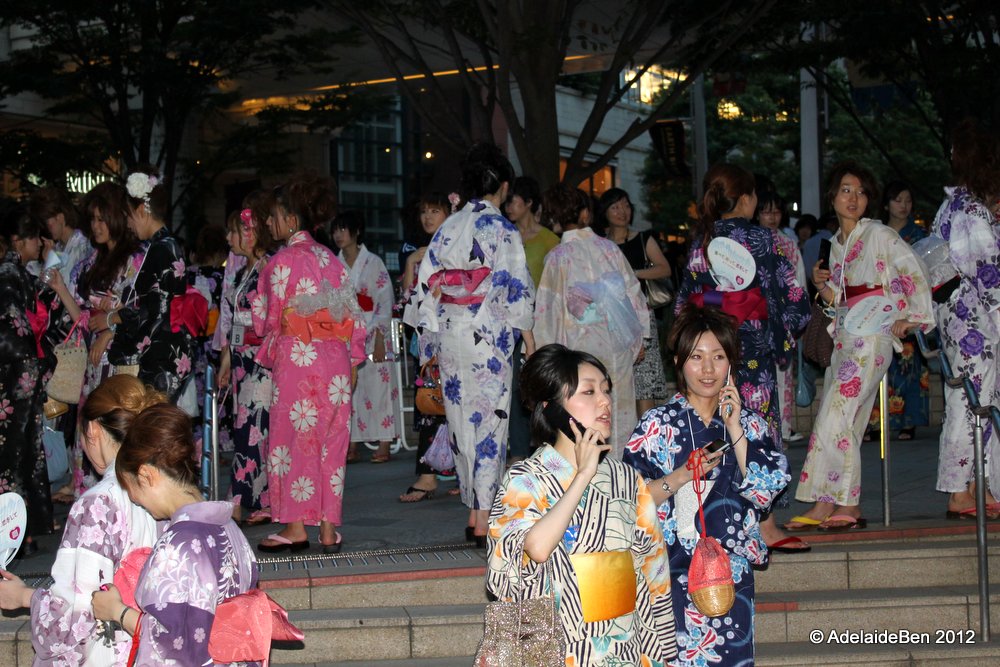
Today however, it was a different thing that was becoming apparent. There was a huge number of women walking around in yukata - or a summer kimono-style dress. It's often worn in summer to attend fireworks in the evening - somewhat of a Japanese tradition. So I wasn't too surprised to see it today...

Though there was no mistaking that there were a lot of young women in yukata all of a sudden... no matter where you looked.


And they all looked like they were going somewhere, or meeting someone...

In fact, as we walked around Roppongi Hills, it started becoming apparent that this was no ordinary evening. This was ridiculous! There hundreds of them. It was like we'd stepped in on a yukata convention.

As we walked down around the block, we came across an even stranger sight. Seemingly hundreds more young women squashed in around a bon-odori stage. This was all right next to the TV Asahi studio building (where we were going to take L-kun to see the Doreamon shop (Doraemon being a very popular Japanese children's character).


L-kun and T-chan went into the shop to have a look around (and to make their own Doraemon character), whilst I milled around outside trying to make head-or-tail of what was going on.  

As the minutes went by, the crowd grew and grew... and the security guards became more agitated. Someone was coming... a big black limo pulled up, and who should pop out? Why Julia Roberts of course....

Meanwhile, L-kun and T-chan were obliviously having fun inside...

And Julia (somewhat un-relaxed looking... perhaps it was the heat), strolled down the red-carpet to be surrounded by the sea of screaming, camera-wielding, yukata-wearing womanhood.

The big screen was as close as this paparazzi-wanna-be was going to get.


And about 30 or so minutes later, it was all over, and the Julia was whisked off again to who knows where. The life of a star. I do wonder, what someone like Julia must think of the whole thing. As it turned out this was her first visit to Japan... promoting the movie Eat Pray Love. From what I saw, she was getting the 5 min culture-shock treatment - though perhaps she gets used to that.

Their screams vented, and normality returning, the sea of femininity parted... and finally dispersed, their Hollywood-star-lust satiated.


Time to relax...

And what came of the women... they just melted away into the night. I have no idea where they would have disappeared to... but they certainly had made for an impressive sight.


Of course, L-kun was none the wiser... and after a long evening of making Doraemon, was happily (obliviously) eating his hard-earned ice-cream.... I could be wrong, but I think Julia would have killed someone for an ice-cream to get her through the heat.


So it's interesting how spare days can turn out bizarrely unexpected. 

Wednesday, July 18, 2012

Minato Mirai 21 - The Future Is Now

18th August, 2010 - After a long, hot day in at Chinatown and then the Anpanman Museum, we walked over to one of our other favourite places in Yokohama. Minato Mirai 21, a typically Japanese entertainment district / business district / port facility that was developed out of land reclamation of Yokohama harbour. Actually the idea came out of the heady 1960's, when the future of Japan beckoned... but had to wait till the 80's when Japan's finances and near-orgasmic-desire-to-build knew no bounds. And thus, out of the sea was born a concrete and steel vista of grand proportions.

The tourist guide has a lot of information on Minato Mirai 21 here, and there's a lot to see and do (more so than we had time after a very busy day). 

View Tokyo Map in a larger map

Still, it was surprising just how rejuvenating it was for the sun to start setting... and as we approached Minato Mirai, the air cooled (not by much), and yet, the streets became strangely quiet. This part of MM21 is much more business oriented I guess, and by 6:30pm the streets were not quite a ghost town, but by Japanese standards it was pretty close.


Our first stop was World Porters, a large shopping complex on the "island" part of MM.... unfortunately no photos, so Google StreetView has come to the rescue. World Porters has a pretty extensive food court available, and is worth popping (along with the much larger Queens Square Towers).

Care of Google StreetView

Food court's are pretty well the same all over... the only thing that changes is the cost, the crowds and the cuisine (ok... that sort of means that every food court is different).

And if you're interested in what sort of prices food court meals are in Japan... well here you're looking at somewhere between 600 and 800 ¥ - in Aussie Dollars that would be approx AUD $7.50  - $10 based on today's rate (about 80 ¥ for each AUD).... drinks separate. 


Well, there was a pretty good selection here, though we went for something traditional. Steak! That's right people, not all Japanese food is the same. Then again, even a dishes like steak tend to take on a different, asiatic, flavour as you might expect.... and the verdict. Well, coming from Australia, where we like our steak big, thick and juicy, it was... ok.

Next stop was Cosmo World, a small amusement park that sports a couple of smallish roller coasters...
It's nice to see Australia front and centre!

 ...and one BIG Ferris Wheel... oddly named the Cosmo Clock.

From this angle it might seem slightly less odd... but for such a big Ferris Wheel (measuring around 100m) you'd think that putting a relatively small clock would not a HUGE clock make).

And some more gratuitous night shots...

L-kun was still a little tired after his long day...


Now, speaking of BIG... one of Yokohama's popular attractions is the Landmark Tower, which stands approximately 296m in height and is currently (at writing) Japan's tallest building and 3rd tallest structure. That's pretty impressive, given that Japan's constant earthquakes have tended to limit the construction of the super-skyscrapers that have developed around the world (in fact, this is only the 80th or so tallest building in the world today). There's a very good observation deck, known as the Sky Garden, on the 69th floor - and 273m high. This is reached through the fastest elevator in Japan... all designed to get you to the 360 degree panorama as fast as possible. That and to quickly unload you of the ¥1000 per adult (between ¥200 and ¥800 for children depending on the age). As we arrived here very late, we decided to give the Sky Garden a miss this trip.


When there's so many other places to visit - like the Ice World attraction, where you too can experience -30 degree temperatures, all whilst it's a hot sweltering 37degrees (with about 80% humidity) outside. With a wife coming from Sapporo, this was not something that we felt a great desire to experience.


One of the attractions that did interest however was this glorious Carousel as part of the even smaller amusement park, known as the Kids Carnival Zone. It actually astounded me that in the middle of a hot Japanese summer (one of the hottest on record back in 2010) that at 8:30pm, there was almost not a soul to be seen around MM21. I'm not sure if this was a sign of the economy, the weather or just the fickle Japanese punter, but for us it was a great night to be out and about. Even as tired as we were, hot summer nights can be fun. And this carousel captivated me, and my camera.


With such an inviting stairway, who could resist taking a ride?


But there were other things to do... a chat with Anpanman and Doraemon (two of L-kun's favourite Japanese children's anime characters)...


Or perhaps ride on a Baikinman (also a character from Anpanman) car... let's just say that this was one Japanese roadway that wasn't congested. At all.


Just down from the Carnival Zone, there's also a beautiful old four-master, the Nippon Maru, permanently moored in Yokohama harbour as a museum. The ship was made in the 1930's as part of Japan's merchant seaman training program. Eventually it was replaced in the mid 80's and since then has been gracefully educating us land-lubbers. Unfortunately opening hours are 10:00am to 5:00pm - so we'll have to take a rain-check on that as well (¥600 per person for high-school students and above, or ¥300 for younger students).


Heading back towards the Landmark Tower we came across a great little ampitheatre that was the home of some very funny and enjoyable street-performers... definitely worth checking out for some 'free' entertainment, but I'm not sure how regular it is. Right next to the ampitheatre is a wonderful modern sculpture known as the "Moku-Moku Waku-Waku Yokohama Yo-Yo" designed by Hisayuki Mogami in 1994. It, along with the Landmark Tower, is a symbol of the Minato Mirai 21 - which was actually a popularly voted name that means the roughly the Future Port of the 21[st century]. MM21 is a modern development and there's much to like about it... but the name also tells you something more... this is, after all, a working port. As we walked around, it certainly felt more like a business district than a life-centre. But perhaps we saw it on a bad night (it was a Wednesday after all).


So as we made our way back to the train station in the Queens Square Tower complex, it was interesting to reflect on our first full day in Tokyo this trip. It was an amazing day - but also exhausting. As we travelled down one of the longest escalators I've been on (and not that enjoyable for someone who doesn't like heights), I looked up to see a happy care-free Snoopy floating past, suspended mid-stride. There are many things that inspire in Japan, and also things that defy explanation. Japan is an amazing country however, filled with many different possible experiences all able to be enjoyed in a single day. Yokohama is one such place, a short train-ride out of Tokyo (though you may not realise that it's a separate city) that is well worth visiting if you've got a spare day - or night. 


Like many places in Japan, built on the promise of an the inexhaustible Future (during the hey-day of Japan's prosperity) there is a sense of modern exuberance and flamboyance... but as the Future collides with the Now in these places (such as MM21 and Odaiba in Tokyo), you realise that Japan is as much a contradiction in perspective as culture. It was the dream of a cleaner, brighter, taller and stronger tomorrow that drove it to build... but one also can imagine that sometimes, just sometimes, people were not always the most important (or even necessary) in that vision of the future... and then again, sometimes that vision needs to be re-interpreted to meet the needs of an increasingly changing Japan.