Thursday, May 10, 2012

Kanteibyo - The Technicolour Temple of Yokohama


18th August, 2010 -  One of the places in Yokohama's Chinatown that should not be missed is the Kanteibyo temple (and a place we visited way back in 2003). It's not a subtle temple, and it would be hard to miss it in the street (just down from Chikyumon or Earth Gate, ie Gate 6 on my previous post). This is also referred to as the Kan Ti Miao temple.


The temple is as much a celebration of colour as it is the enshrined statue of Guan Yu... the famous Chinese general under Liu Bei who would become the first emperor following the collapse of the Han Dynasty (around 200AD). This story became the basis of the movie epic Red Cliffs. His life was one of romance and myth, and indeed his military exploits leading up to the civil war lead to him being deified around 600AD... although it's not clear to me if he's deified as the God of War or the God of Business (perhaps at one level these are one and the same). The temple was first constructed in 1862, and quickly became a tourist attraction, as it remains today. It had a chequered history however, having been destroyed in the 1923 earthquake, then again in WWII, then burnt down in 1981... AND in 1986. Each time being re-built in even grander scale. This temple was completed in 2000.

 The temple gate is the most immediately striking element of the temple... the detail is exquisite.


From inside the temple, it's not quite as dramatic, but not by much.


Like in many of these temples, there can be found a large urn/container for burning joss-sticks... and it's always thought to bring good luck to waft the incense smoke from the sticks over yourself.

And of course, it wouldn't feel like a Chinese temple without some lions.... 


But the big attraction is of course the main hall, where Guan Yu is in permanent residence. Now, I have to admit that I am no expert on Chinese history, though I did watch Red Cliffs (both of them)... bit boring actually, but that's a different story. Anyhow, I'd advise hitting the web if you want to know more... but apparently he is often depicted as having a red-face. Perhaps he was just a very angry man... I don't know.... He's synonymous with loyalty and bravery. He also came to a gruesome end... in two parts (his head being one of them).

Although, in a scene reminiscent of an Austin Powers movie, it would appear that good ol' Guan Yu had his very own, mini-me. I wish I had a mini-me... well, I suppose I should stop calling my son that... ?:-)


And whilst you're here paying your respects, don't forget that the hall itself is a wonderful sight as well. It's nice to just stand and admire it for a while.  And yes, this temple is fan-enhanced for the devout (and tourist alike).

Once again... the level of detail everywhere is incredible as it is ubiquitous... and colourful. 

The temple is open freely to the public... and I mean free... from 9am to 7pm at night. They do request (if you want to take photos) to make a small donation... well, actually, the way they say it is that you should pay to pray, and then whilst you're being all humble and reverent you can snap off a few shots for extra good luck.

The final thought on the temple is that in most photos of the temple, the photographers go to great lengths to hide one dominating aspect of it. The road in front of the temple is a jungle of overhead power/telephone/internet cables. 

Whilst they may power the vitality of Chinatown, I can't help but feel a bit sad that even here a little more effort could have been made to keep these low key. Then again, this is Japan, and it would seem the Japanese have an ability to look past the unpleasantness in front of them, to the beauty behind. That's not such a bad thing I suppose...

Sunday, April 29, 2012

Gate-Crashing Yokohama...When Is Wednesday Also A Mon-Day?


Chinatown is approached through a number of gates, or mon in Japanese (門), in traditionally flamboyant style... though they can be slightly odd, sitting in amongst the normal traffic signs. There are 10 gates all up in Chinatown, arranged according to the Chinese art of Feng Shui - bascially a throwback to the ancient beliefs relating to superstition to shape, structure and colour. The first four are the most important, relating to the Four Symbols in the Chinese Constellation. Whilst it was my intent to take snaps of them all, the reality was that the oppressive heat beat me. So here's just a few of the shots that I did manage to take before heat exhaustion threatened to get to me. I've also made use of Google StreetView to help with the rest... it's kinda cheating, but... I've also made use of the info on the official Chinatown website - though unfortunately this part is in Japanese only.

I've made up the map below so you can reference the gates by numbers (in no particularly meaningful order):
Map care of Google Maps.

1. The East (東) Gate or  Chouyou-mon (朝陽門). This gate relates to the Azure Dragon God, and brings prosperity. The Azure Dragon is said to relate to the East, and Spring - and is associated with the wood element. It was only opened in 2003, and is the largest of the gates.

1. Chouyou-mon

2. South (南) or Suzaku-mon (朱雀門). This gate is associated with the God Suzaku - the Vermillion Bird - and hence the colour red. It relates the generation of good fortune from disaster, and is also related to the fire element, the direction South, and the season Summer.

2. The Suzuka Gate (source: Google StreetView)


3. The North (北) Gate or Genbumon (玄武門). This gate relates to the Black Tortoise, and is associated with the God Xuanwu (in Chinese) or Genbu (in Japanese). The gate is linked both to the North and to the season of Winter.
3. Genbu-mon (source: Google StreetView)
4. The West (西) Gate or Enpei-mon (延平門). This gate is related to the White Tiger God of Chinese astrology, and is known by Baihu (in Chinese) or Byakko (in Japanese). Actually the White Tiger (the West Gate) and the Azure Dragon (the East Gate) were said to be brothers, and reincarnated as two ancient Chinese generals. It represents the direction of West, the colour white and the season Autumn. The gate relates to eternal peace, as the legend goes, the tiger's tale turns white at the age of 500, and only appears when peace exists across the world.
4.  The Enpei-mon (source: Google StreetView)
5. The Prayer for Good-Neighbourly Gate (平和を願う善隣門) or Zenrin-mon. This gate was originally constructed in 1955 when the area was known as Nanjing Town. It was later re-signed as Chinatown, and renovated in 1989. It is perhaps the symbol gate for all of Chinatown now.
5. Zenrin-mon

6. The Chikyumon or Earth Gate (地久門). This is the first of the pairs of gates that stand at the Western and Eastern ends of Kanteirou dōri , which are basically representing Heaven and Earth (or... should that be Earth and Heaven). There are two important areas that can be accessed from this road, but I'll talk about them in subsequent posts. The matching gate is gate 7.
6. Chikyumon
7.  The Tenchoumon or Heaven Gate (天長門). The second and Eastern of the two gates.


8. and 9. The Market Street Gate or Ichibadōrimon (市場通り門). This is the second of the pairs of gates, and can be found, not surprisingly, on Ichibadōri. It may not quite look like it today, but this street is normally a thriving centre of activity. I'll explain why that wasn't the case in the next post...
8. Ichibadōrimon (1)

9. Ichibadōrimon (2)

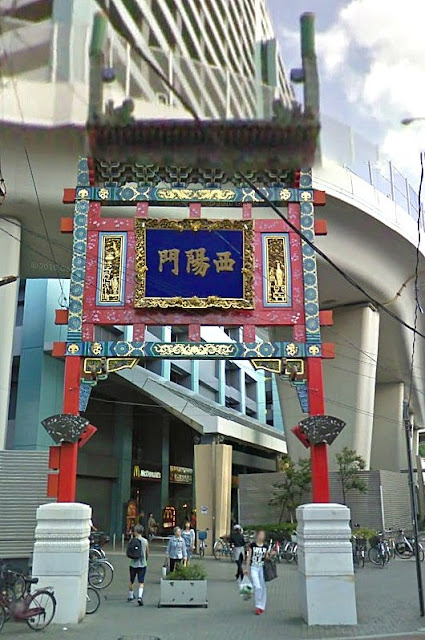
10. The Seiyō or Closest to the Western Sun Gate (西陽門). This gate is named so as it's supposedly closest to the Suns light on the Western side. Hmmm - looking at the map on Google, I'm not entirely sure about that. To be honest, it's also a very strange place to have a gate, snuggled as it is right next to an over-pass.
10. Seiyō Gate (source: Google StreetView)

Looking back at the Eastern Gate, there's a lot of detail in their construction - as is the wont for Chinese gates. There's a lot of work in these things, and I do wonder if it's a specific set of skilled artisans that go around the country (or the world) making Chinese gates. A little note of explanation. Each of the gates have two signs... the outer side (see the first image above) says Chinatown, the inner side gives the gates name. Below is the sign for the Chouyon-mon or  朝陽門 ... in Chinese characters, this is read, right to left...門陽朝..


Whilst the light was not the best for photographing (hmmm... this was clearly before I started playing around with HDR photography), I love the complete crazy psychedelic colours in the Chinese (Japanese) architecture... I can just imagine what it would have been like back in the day, being a paint salesman in ye olde Japan. 


Subtlety was not one of their strong points, I fear....


I'm not sure how long the gate took to complete, but it's certainly an amazing work or art, and a grand way to welcome anyone into Yokohama's Chinatown. Whilst. I'm not sure if gate-spotting as a hobby will catch on, but it is fun to explore the whole of Chinatown to see them all. Although I've still got 4 to find on one of our next trips.

Thursday, April 26, 2012

Hitting Yokohama's Chinatown - Till It Hurts...


18th August, 2010 - One of our favourite places to visit when in Tokyo, isn't even in Tokyo. Yokohama is a separate city that lies to the south/south-east of Tokyo, less than 50 kms away from the heart of Tokyo. And it's definitely one of the places I would recommend as a 1 day trip outside of Tokyo (with Kamakura being next on my list). In fact, you might have to be quite observant to realise that you've left Tokyo at all - as it's sprawl all the way there. Indeed, Yokohama is the second biggest city in Japan. Though it might seem you are escaping one megapolis for another, that's far from true. Yokohama has a much different vibe to it. This is the second time we've been here (the last was over seven years ago... check out here)

View Tokyo Map in a larger map

The best way to get there is most probably on the JR Tokdaido line out of Tokyo Station (about 27 mins) and costs about 450 yen (or you can take it from Shinagawa Station for about 290 yen). Other alternatives are the Keihin Tohoku line (same as above, but slower) or the Tokyu Toyoko line from Shibuya. The best option likely depends on where you're basing out of, and where you want to go, as the train lines will serve slightly different areas.

Now - if you need a map around Yokohama... you need only look down. There's wonderful stylised maps (in the style of the Japanese man-hole cover artwork) scattered all over the city. And what more do you need than the one, sponsored by... er your local Telco...  By the way... if you're looking for a slightly more conventional map, then try the following pdf map from Yokohama Visitor's Guide.


One of the big attractions in Yokohama is the Chinatown, or Yokohama Chukagai... although it might seem incongruous to visit Japan, only to go to a Chinatown. It's the largest in Japan, and one of the largest fullstop (of course, not including just about anywhere in China) - and a well-travelled destination for many travellers to Yokohama.


Yokohama was actually one of the few prescribed trading centres in Japan, and a natural entry point for Chinese as well as other western traders - after the opening up of 1859. Things slowed down (for obvious reasons) during and after the war, but it remains a vibrant centre of Chinese culture, and importantly cuisine, in Japan today. There's not a great deal of real historical remnants to the city, having been mostly destroyed in the 1923 Great Kanto Earthquake, and then again during the fire-bombings of WWII. We'll touch on some of the cultural elements in a few posts...

Yet there remains a distinctly Chinese ambiance... even if it has taken on a bit of a kitsch over-tone. And don't get me started on very touristy souvenir shops...

Or the much more enjoyable (though still cliche) building architecture... 

Though some of the building detail work in the buildings was impressive...


There are definitely some odd things around as well... I still can't quite work out what these street markers were supposed to be (it's most probably obvious to everyone but me)... 


And somethings were just dramatic in their seemingly casual placement... not sure if this is the Feng Shui at work here. I certainly got some good energy from it (unlike the building it was attached to, which was largely falling apart).

 One of the things I love about Yokohama's Chinatown is the exuberant window displays... 


Though some left a little to be desired...
This actually reminded me a lot fo the lion foot that we came across on our last trip here.

One of the best reasons to come to Chinatown however is for the food... although I have to admit that we don't too bad in that area back in Australia either... But Chinatown here is in a whole other league. There's so many food places to visit...


Each of the restaurants just a little more colourful or different than the last. There was only one small problem however.... and this is one that I can't emphasise enough. Chinatown is VIRTUALLY CLOSED on Wednesdays. Ok - there's still a lot to do, but most of the restaurants that we wanted to visit were closed. This was not mentioned in our trusty Lonely Planet guide (or for that matter the Japanese guide that T-chan was using). Now that was a disappointment, as over-filling our bellies with glorious Chinese cuisine was one of the plans for the day. However, we adapted quickly enough (sweat running out of every pore will do that to you)... and grabbed a less than inspiring meal in a local cafe (which I might add had terrible service... but even then we weren't put off).

In fact, such was Yokohama's hold on us, that not even the weather put a dampener on our time...


Now, when we came here, it was (like most of Kanto's summer days) boiling wet. No - not boiling hot. It was too humid for that. Instead, we just boiled in our own juices. Bring plenty of money to buy sports drinks (aka Pocari Sweat etc). You'll definitely need them if you're travelling in the summer. Or you could always try a refreshing mango smoothie.... though I'm not sure if there were some 'special' ingredients in that drink...

The pictures definitely don't convey just how damn hot it was... and indeed it was so hot that the buildings were spraying their customers with water to keep them cool. At least I think that's what they were doing... and I think that was water... perhaps they were just for the greenery...


But the realities with are with a 3 yo, in the middle of summer, there was always going to be one way this was going to end. With Daddy providing some physical (more than moral) support.

But children are resilient... and 30 mins later, L-kun was running around like he had an infinite supply of energy. This, as it turned out, was directed mainly at a new game he'd discovered. Following in people's footsteps - indeed preferably before they got out of them. About 5 seconds after this photo was taken, L-kun's game ended abruptly when he stepped on T-chan's shoe and broke it. Let's just say she was hobbling most of the day before she could arrange a replacement.

Even walking around Yokohama in broken shoes, on one of the hottest days of Tokyo's hot 2010 summer, with most of the restaurants closed wasn't enough to spoil the day for us.... We love you, Yokohama's Chinatown - even when it hurts... which T-chan's feet were starting to do. And whilst it wasn't the best start to the day, it was a great day, and we had a lot of fun - which we'll go into in more detail over the next few posts.

Thursday, March 22, 2012

Grilled (Tourist) Meat in Musashi-Koyama

17th August, 2010 - It was a hot, balmy Tokyo summer's night. And we had been enjoying our first afternoon in Tokyo, awaiting T-chan's brother (H-kun) to finish work and meet up with him at his home in Musashi-Koyama. The one thing you should know about work in Japan however, and especially in Tokyo, is that you shouldn't make too many plans regarding when people finish of an evening. As it turned out H-kun was stuck at work, and his fiance (S-chan) rushed in to help out. We met her at Musashi-Koyama Eki (train station), and quickly set out to grab some dinner. It was already well past 7pm, and we were getting hungry.... in Tokyo, things move at a fast pace and you do what you can when you can.

Now Musashi-Koyama's not necessarily a household name... but it's about 1.5 km from Meguro station on the Yamanote line (2 stops by the local Tokyu Meguro Line, and 3 mins). Not a bad place to live at all.

View Tokyo Map in a larger map

First night in, we thought we'd have something simple for dinner. Yakitori (grilled meat/chicken) is always a great way to start an evening. S-chan took us to a small place just around the corner. Very convenient. Whilst L-kun had met S-chan before, he was still being a little bit coy. Still... the way to any boys heart is through his stomach (and of course presents).

That yakitori-ya was nice decorated in a rustic theme. The one thing I like about Japanese interior design is when it turns towards more naturalistic materials and structures (as compared to the countless pre-fab and concrete designs that are also common). Of course, this is often used as facade only (hiding the fact that it's really cheaper building materials deep down that's holding the place up). I especially love the look of rough hewn wood... but I digress... 

I have to say that whilst the place had the ingredients of a normal yakitori-ya, it didn't take long to realise that this was perhaps a little more up-market than the normal place you'd find nestled in a busy Japanese street. And to be honest I normally think of yakitori as being a cheap meal (except in our home in Adelaide, where it's treated like haute cuisine and comes at a premium price... silly Australians). So with that in mind we got stuck into ordering...

We ended up buying lots of little dishes... below are just a small sample of them... yummy. I love yakitori (in all it's forms, flavours and associated dishes). Hmmm... I'm getting hungry again!...
Sarada pasta entree (served with the drinks)

Uzura-no-tamago (quail egg)

Asupara-bacon (Asparagus, bacon drenched in cheese)

Chicken yakitori with spring onion


(left) buta or pork, and (right) tsukune or chicken mince-balls

Needless to say that we ate dish after dish - and before long I had given up taking photos. Even though it was a stinking hot day, we certainly had our appetites! And as it was our treat, we could enjoy heartily. Of course, until it came to pay the bill. I did say it was a little upmarket didn't I... and the bill reflected that. Still, it may not have been cheap street yakitori, but  it was delicious nonetheless. It was fitting that we should have enjoyed grilled meat, after becoming grilled tourists for most of the afternoon. Kind of cannibalistic if you think about it.

After a lovely dinner we headed back to H-kun's mansion...ok strictly speaking it's a manshon... in Japan a manshon simply means an apartment. Sorry to disappoint. This should not to be confused with an 'apaato' (apartment) which is generally a more temporary construction, smaller building... I think... it's all too confusing really. I guess words sometimes just don't quite make the transition between languages.  Anyhow - it was nearing 9pm and the streets of Musashi-Koyama were amazingly quiet. To be honest, I had expected (given how central it was, and the fact it was in the middle of summer) for the streets to be alive with people. It seems that the heart-beat of Tokyo isn't too dissimilar to any other city when you get down to it. It also showed that you could find suburbia in even the biggest of megapolis.

It was a hot night that night, and our trip to Tokyo had only just begun... and finally by about 11pm H-kun arrived home after a typically long day at work. It was good to catch up with him, but we also knew that he'd be busy for most of our stay in Tokyo. Such is the curse of working in Japan.