Wednesday, July 7, 2010

Lighting the Way...Kasuga Taisha Style


25th October, 2006 - Further up the hill from Tamukeyama Hachiman-gu, we walk further back in time - back to the time of Fujiwara-no-Fuhito, who figured so prominently in the making of Nara. There were two religious centres that were associated with the Fujiwara family. We've already seen the first, Kofuku-ji. The second is Kasuga Taisha.

As mentioned, Fujiwara-no-Fuhito (659 - 720AD) was centrally involved in the development of Nara, and had manoeuvred his clan in line with the Imperial family through marriage. It's good to have daughters if you're an up-and-coming noble. The same smallpox outbreak that had inspired Emperor Shōmu also however killed each of Fuhito’s sons in 737, thus forestalling the Fujiwara clan's rise to power.

From Tamukeyama Hachiman-gu, you arrive at the side entrance... Actually for over 1000 years there was a very strong link between the Shinto shrines and the Buddhist temples - a sort of co-evolution that only came to an end with the Meiji Restoration. This shrine is dedicated to Ame-no-Koyame - he is considered the ancestor of the Fujiwara. I always get the feeling that the deities of Shinto largely sprung from real people, glorified and ancestor-worshipped until they eventually took on a spiritual existence... around which legends grew. Then again... what do I know... ?;-p

The shrine is surrounded by bronze lanterns - donated by patrons. Of course - the donations weren't merely to the shrine, as there was an undeniable link between the powerful Fujiwara clan and what was essentially their own family shrine. Not that I'd cynically equate donations with power...

The Nandai-mon is the main entrance to the Shrine. This shrine is supposedly one of three most important Shinto shrines in Japan. I'm not sure why - or even who says these things. The Japanese love ordering things however - and I suppose when you've got so many shrines and temples, pecking ordering is important.

The lanterns line many of the walls and passageways. Nowadays the shrine has a feel of solid permanence... however the shrine itself was originally designed, like many in Japan, to be rebuilt every 20 or so years. That tradition has stopped however - clearly it takes a long time for the resident kami to put down roots.

Below is sort of the quintessential photo of Kasuga Taisha... why... well, if you're like 95% of the foreign tourists that come to Kasuga Taisha, then you're a tight-wad and this point is the furthest you can go without paying the admission price. The fence is carefully cropped out.

Yes - we'd finally reached our limit of temples that day and decided that we'd forego the experience and just view the shrine from a distance. Actually, this shrine is the basis of a complete Shinto shrine style known as Kasuga-zukuri, and is the second most common shrine style in Japan. Also if you are a tight-wad, then there's plenty for you to see in the vicinity of the shrine. Especially if you like stone lanterns.

Nara Kōen is well known for it's lanterns (both stone and bronze), and as you move up into the hills you find more and more. Lanterns are used beyond and within the shrine – and the Lantern festival is held here twice a year - unfortunately for us, those two times were February and August. Below is the view of the Nandai-mon from the outside.

There are around 2000 lanterns scattered across the park, and the Kasuga Taisha has the lion's share of them. You'd almost think you'd stumbled on a Lanterns-R-Us discount shop... everything must GO... crazy Crazy CRAZY! You like lanterns - we've got lanterns... out our wazoo.

 I can't imagine how long it takes to light all of the candles in the Lantern Festival (or how many matches give their lives)... it must be an incredible sight however. I'm sure in the twilight the forests of lanterns must make for an equally eerie sight.

Lanterns to the left... Lanterns to the right...

Stone, trees and moss... a perfect combination. Each of the stone lanterns, like their bronze counterparts, were donated to the park and shrine by worshippers.

As the afternoon settles in, we finish up with the lantern forest. The way down is always easier. My thoughts dwelling on the age old question. Is there such a thing as too many stone lanterns?


And then when you've had your fill... you can always return to main park and re-acquaint yourself with the deer. These animals are considered sacred in Nara - as the legend goes, the four spirits (kami) of Kasuga Taisha were brought to Nara on deer-back. Now they have free reign of the park...  And they want food... or anything that looks like it could be food. October is not a fun time for the deer however - every year the deer are de-antlered in October. Stops them getting too "keen" both with each other and the park visitors.

After our whirlwind visit through Nara - we went to the Nara National Museum to have a look through the various historical artifacts and objects from ancient Nara. At the time there was a special exhibit on... all about treasures from Emperor Shōmu's private collection. Actually, it sounded more interesting than it was. For the life of me, I couldn't get that into a short note written by someone to someone else regarding some administrative matter. Even if it was 1,000+ years old. It just lacked a personal touch to me (but perhaps that's just a cultural/language divide). Still they have some nice artwork in the museum... but unfortunately no cameras allowed. It was also a great opportunity to see some real otaku (nerd) Japanese that poured over each small item in awed wonderment. We even had one ojisan complaining derisively to us that the museum had made a mistake over one of their exhibit descriptions. Tsk tsk. Naughty museum.

As the night draws in, and the sun sets, we catch our breath, enjoy the view, and head back to Kyōto... we'd like to have stayed here more - but both T-chan and I were starting to wilt.

Posted by Picasa

Tuesday, July 6, 2010

Nara... The Forest of Yore


25th October, 2006 - So far we have travelled through Buddha's Nara... clean, grand, and a testament to human striving to conquer the world, and our own frailties. There is however another Nara, just as ancient if not more so... beyond the vermilion torii... This world is much older and much more primal in nature. It is a world of the Shinto spirit (or kami) worship. As you move further into Nara Kōen, you find yourself moving deeper and deeper into the old Japan... although this is hardly the wilds of Japan. For a good feel of Shinto beliefs and shrines, please pop into More Glimpses of Unfamiliar Japan which is one of the best blogs on traditional Japan on the net.

And of course - Japan is famous for it's trees. This one has most probably been through a bit...
Walking up the mountain, you come first to Tamukeyama-Hachiman-gu .The Shinto of ancient Japan was more about worshipping sacred locations, or even "things"... however following the introduction of Buddhism into Japan in the sixth century (what with it's ceremonies and temples), there was a distinct transition in the way Shinto was observed. The Japanese are very good at adopting new styles, and the Shinto belief system adopted the dedicated shrine - indeed this gateway owes a lot to early Chinese tradition.


Looking back, we are always able to reflect on how far we've gone. The first signs of Autumn, promising of all the great views we would miss out on... for a later trip.

In a very amicable way, the god Hachiman had taken on (willingly or not) the role of protecting the Buddhist temple of Tōdai-ji. For many centuries, the line between Buddhism and native-born Shinto blurred. Following the Meiji Restoration and the ascendancy of the State-based new-Shinto religion, such cozy relationships between the two fell fell away as easily as discarded clothes. In previous centuries, it was often the Buddhist temples that supported the Shinto shrines.

I love the juxtaposition of the photo below, what with the earthen  and age-worn walls, the roof tiles, the white Japanese shide decorations. This more naturalistic look speaks much more clearly to me of Shinto's origin than the familiar vermilion red paint that we can see through the gateway.

It's not so easy  however, throwing off the influence of over a millenia of Buddhist influence! Turning left (towards the north), we re-enter the Buddhist world as we approach Sangatsu-do, named after the Buddhist scripture (or sutra) reading that occurs in March (san - gatsu... 3 - month) - then onto Nigatsu-do... let me guess...named after sutra readings in february (ni - gatsu... 2 - month)?

Towards the back of the temple we see the direct evidence of the cross pollination of religions. This area is very Shinto in feel. The stone basin is for performing misogi harai - or temizu - the washing of hands (and in previous times, the mouth). This purification is Japanese - and specifically Shinto - in origin.


The Nigatsu-do is particularly impressive... it's not quite up to Kiyomizudera standards (he says telegraphing a future post), but it's a nice vantage point with which to take in the surrounds. To reiterate the point from before - these two religions are joined, for the most part, at the hips. See the mini-mini torii in the foreground - this tells us that "here lieth sacred Shinto ground"... what we lack in size, we make up for in occasional shade from this tree. It's all about street frontage.


The panorama from Nigatsu-do is sweeping to say the least.


The daibutsuden stands off in the distance, the city of Nara beyond. Nigatsu-do is very much a sub-temple of Tōdai-ji.


As you move past the Takuyama Hachiman-gu again, you will eventually reach a street of tourist and food shops, at the top of the park. After a long day of walking around, the food was welcome (especially for T-chan), but don't expect the Ritz. Pretty basic tourist standard.

Departing Nigatsu-do, we pass back into the forest - and finally there's a sense of moving back in time... 


Except for... a 7-11 from olden times... deep in the forest we came across this very interesting convenience store.... well, I'm not sure you can expect them to franchise anytime soon, but it made for a very different experience. And no... it's not quite Lawson... just the bare basics of food / drink etc.


Next stop... the time before yore. That's right.... it's pre-yore. 
Posted by Picasa

Sunday, July 4, 2010

Todai-ji... Bigger than AdelaideBen Hur


25th October, 2006 - Leaving Kōfuku-ji we approach Tōdai-ji along a well-trodden path...Construction for “Great Eastern Temple” started around 734AD, under the direction of Emperor Shōmu. He had the grand vision of creating both the largest bronze Buddha and the largest wooden building the world had seen. He would succeed at both goals, and it remains true today. Suffering from illness that threatened to take his life, he had the great shrine dedicated in 752, prior to it’s completion. The gold finishing was only applied after his death.

Tōdai-ji is approached through the Nandai-mon (or Great South Gate). The present gateway, dating from 1199 AD, is but two thirds in size of the original which was destroyed by a typhoon in 962. The two Nio were constructed by borthers Unkei and Kaikei, two of the leading sculptors of the time...no piccies though *sigh*. They are impressive.


Continuing down the boulevard, you approach the Chu-mon, or central gateway. This is only opened on special occassions, so you normally need to go through the smaller (uninspiring) gateway on the left.

As with the Nandai-mon, the gateway is protected by the guardian kings.... We'll be introduced to these more shortly...


The Great Buddha Hall (daibutsuden) is the largest wooden building in the world standing at some 187 by 165 feet, and up to 159 feet high. The present building was built in 1709 (the result of the original burning down a decade earlier). This building is somewhat smaller than the original (about 2/3rds once again), and the two seven-storied pagoda that used to stand either side are no more. Emperor Shōmu reportedly set about developing Tōdai-ji following a number of calamities hit Japan (including small-pox epidemics).... it was somewhat ironic then that his daughter, Empress Shōtoku almost brought the Imperial rule under direct Buddhist control, and in the end she also died of small-pox.

The decorations are the remnants of the celebrations that occured on the 21st October (at the same time as Jidai Matsuri back in Kyōto). They add a slightly incongruous air to the temple, as if it were some giant birthday cake.

Approaching the building there's a real sense of the size...this truly is the house of the Great Buddha. Daibutsu-den. 


The bronze Buddha statue is some 49 feet high, the upturned hand alone is over 6 feet high was originally cast in 746 AD – and has been re-cast twice since. It contains some 437 tonnes of bronze and 130 kg of gold. During it's manufacture, the majority of the bronze output of Japan was funneled into its manufacture - almost bankrupting the country. Such was the devotion of Emperor Shōmu, and the power of the Imperial throne. It was completed in 751, and the eye painting ceremony, conducted by an Indian priest, was done in 752.

The Buddhist faith is somewhat complex, and like many of the worlds religions it is somewhat multi-faceted. When we think of Buddhism in the West, our thoughts perhaps naturally turn to the historical "Buddha", or as is known in Siddhatta Gautama - or more commonly in Japan, Sakyamuni. However the Buddha represented in Tōdai-ji is Vaircona Buddha (or birushana-butsu), the Celestial Buddha, whose light shines through all Buddhas. The position of the hands has religious significance: the right denoting peace-of-mind, the left the granting of wishes. This is what you call a Great Buddha (daibutsu)!

To the left of the daibutsu is Kokuzo-bosatsu... where bosatsu (or bodhisattva) are beings - at least in the Mahāyāna school of Buddhism in Japan - that have essentially attained enlightenment but have elected to remain in the world to help others.


To the right of Great Buddha is the Boddhisattva Nyorin Kannon (who grants wishes using the centamani jewel his hand).


These statues were originally protected by the Shitennō - the four (shi) kings (tennō), of which only two remain.
Kōmoku-ten (Guardian of the West) holds paper and writing brush to record the sins against the Buddhist truth;
Tamon-ten (Guardian of the North) holds a pagoda in his hand, to show his symbolic protection of Buddhism;
Jikoku-ten (Guardian of the East) draws his sword in defence of Buddhism; and
Zōjō-ten (Guardian of the South) holding a staff as both symbol of office and weapon.

Kōmoku-ten...His name means wide eyed or expansive vision.

Tamon-ten...One who is all knowing, and all hearing. The pagoda represents the treasure house of Buddhism, it's rewards given only to the righteous.

A rather strange image stands - or should I say, sits - outside the Daibutsuden, just to the right of the entrance. A giant chair, upon which a rather disturbing wooden statue sits cross-legged, cloaked in red bib and cap. This is Binzuru-Sonja, a disciple of the historical Buddha Sakyamuni. He is most famous for having the ability, so the legend goes, to cure all ills if you rub him, then the body part which is sick. There is another legend that says that due to a fall from grace, he is forever forced to wait outside the sacred temple.

Looking back across to the Chu-mon, we see a great octagonal lantern dating from 752. The eight sides are decorated with Korean dogs, and artisans, and the lantern is adorned with the centamani, a jewel favoured with the granting of wishes.
The temple was built under the guidance of the Kegon sect monk, Rōben, although the early years of Tōdai-ji is often associated with a Chinese monk, by the name of Ganjin, who had been invited from the mainland to provide spiritual guidance. After five unsuccessful attempts to sail to Japan over 12 years, he finally made it on the sixth attempt, arriving in 753, by which time he was completely blind.

The clouds part momentarily as we leave Tōdai-ji... the gold ornaments atop the great building shining strongly. In many ways, I feel the daibutsu of Kamakura is more beautiful, and perhaps more inspirational for all that it sits out in the elements. However, the scale of the daibutsuden is truly awe-inspiring. To think that this was constructed originally over 1250 years ago... and then it was even grander than it is today.

Posted by Picasa

Saturday, July 3, 2010

Nara - Kyoto Mark I... What the... Kofuku-ji


25th October, 2006 - It's only the start of the fifth day in Kyōto, but it seems that we've seen so much already. Today we were heading out to the nearby city to Nara; one of the former capital cities of Japan, and only a 30-45 min train trip from Kyōto Station. Nara was the seat of power in Japan from about 710 – 784 AD, before Emperor Kammu (the instigator of Kyōto) decided to escape the grip of Buddhist power that had come to dominate over his court. As it stands now, Nara is famous for three things: the Buddhist temples of Nara park (Nara Koen); the temples of the southwest, in particular Hōryū-ji (which is now the oldest existing Buddhist temple in Japan); and the Kofun burial mounds.

As you can see from below, whilst we talk about Kyōto , Osaka and Nara as three distinct cities, the reality is that they are rapidly forming a single concrete megapolis (though I'm sure they still remain proudly distinct 
culturally).


The capital Nara (then known as Heijō-kyō) was initially planned by Emperor Mommu prior to his death in 707, then later completed by Fujiwara-no-Fuhito in 710. It had all of the proper ingredients suitable for a capital according to the ancient Chinese geomancy: protective mountains; two joining rivers; fertile land. As with Kyōto, the city was designed after the ancient Chinese city of Cháng-an, with broad boulevards setting out a grid-like pattern. It was Fuhito’s grandson (Emperor Shōmu) that would expand the city, and build upon it’s rich Buddhist infrastructure. This was in part due to the occurrence of a smallpox epidemic which hit Japan in 737 and destroyed much of the population. Shōmu sought redemption (for such a catastrophe must be caused by some sin of the ruler) by becoming a devout Buddhist and in doing so, seeking the protection of the state through the guidance of Buddha. And the priests.

Whilst it's possible to see more than one area in Nara in one day, it'd make for a very, very long day. As such we, decided to only concentrate on one area - Nara Koen. From Nara Station, it's a short walk (1.5km)... and if you make a small detour (see B below), you can visit one of the ancient Kofun burial mounds - actually where the 9th Emperor of Japan was buried, Emperor Kaika.... Though to be honest, as we didn't have a detailed map, we missed it.

The first of the temples belonging to Nara proper, and the head of the Hossō sect. The Kōfuku-ji (the Happiness Producing Temple) was constructed in 710, or more precisely relocated from the previous capital, Fujiwara-kyo to become his own family temple. Such was the power of the Fujiwara family at this stage that the temple was always supported generously by the Imperial family, with some 175 buildings at its height. The temple used to hold a hospital, orphanage, old persons home, and public bath-house.

The most striking feature of Kōfuku-ji is the pagodaThe five storied pagoda was first constructed in 730, but the present one (below) dates from 1426 – and standing at 50 metres in height, it is the second tallest in Japan after the one at Tō-ji
.

At it's base are housed four Buddhas: Yakushi the healing Buddha (east), Shaka the historical Buddha (south), Amida Buddha of the Western Paradise (of course, the west), and finally Miroku the Buddha of the future (north).


Next to the pagoda sits the Tōkondo. This would normally be but a secondary hall of worship, but with all of the turmoil that has befallen this neck of Nara, this has now come to be the main place of worship. An interesting insight into the ways of the monks back in the olden days... after the temple burned down, the monks were somewhat put out that their treasured  art were destroyed that they went off (piously...) and ransacked a nearby temple to get their treasured art. They then built this hall around those images... possession was nine-tenths of the law back in those days too.

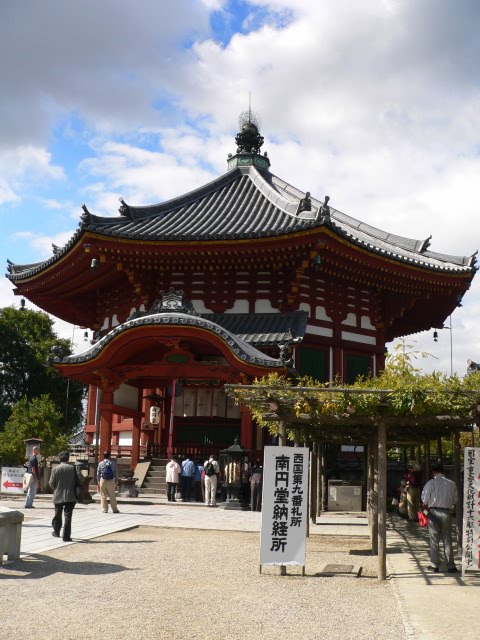
One of the first things that you see coming into Kōfuku-ji from Nara Station is the Nan'en-dō, an unusual octogonal hall. The main treasure inside is a statue of the Fukukensaku Kannon... however, this only gets opened once per year - on the 17th of October. Missed out by > < this much.


Behind the Nan'en-dō is the three story pagoda, Sanju-no-to, that dates back to 1143. Whilst not as visually impressive as it's big brother, it retains much of the original feel and artwork.


In many ways, this is not that impressive temple complex in that it sits in a large cleared square - the site of the original temple - but as if it were plonked down here as an afterthought. There's no sense that this quite fits.

It was the Emperor Shōmu's daughter, Empress Shōtoku (who became Empress twice and was given a new name each time, and died in 770 of smallpox) who would almost bring about the complete enthrallment of the Imperial Throne to the Buddhist monks. She had an infamous affair with a priest , known as Dōkyō, who is thought to have nearly become Emperor. Whilst Shōtoku was the sixth of 8 women to rule over Japan as Empress, following the Dōkyō, it would be another 850 years or so before there would be an Empress again.

This growing power of the temples over the Imperial line lead the young Emperor Kammu to escape, first to Nagaoka and then finally to where present day Kyōto lies. Unlike previously abandoned capitals however, this one retained much of the majesty through the continuing existence of the Buddhist temples of Nara.


In 1180 the Taira destroyed Kōfuku-ji, Tōdai-ji and with them much of Nara during the Gempei War with the Minamoto clan. Thankfully both Kōfuku-ji and Tōdai-ji were reconstructed... and then Kōfuku-ji was then almost totally destroyed again in 1717. With the rise of the anti-Buddhist Meiji government however, the temple was harshly treated, and gradually torn down like many other such temples. It’s main restoration has only occurred recently.

The deer's of Nara Koen take it all in... when they're not pestering you for a feed.


Our next stop along is Tōdai-ji itself. The road approaching, like many temples in Japan, is lined with shops selling food, gifts, and all assortment of tourist crap. This isn't a new thing - as these temples have been tourist magnets for many hundreds of years.


Posted by Picasa