Sunday, December 5, 2010

A Date with Death - Meeting Ancestors For Lunch

18th May, 2008 - We took L-kun up to visit Otousan's father... in Takino Reien... an enormous cemetery to the south of Sapporo (which I've posted about before here and here). We normally visit this cemetery every trip back to Sapporo, and it's an important part of our family time. Plus, it's also a very nice drive.

I thought it might be a good time to talk a little more about Japanese burial. According to a 2007 census, 99+% of Japanese are cremated... not sure how they managed to have a census of the dead though. Scary thought really. Cremation was brought to Japan with Buddhism in the 7th century... I had assumed that cremation had always been a part of Japanese culture, however, it was only 27% in 1896 and 54% in 1955. These surprisingly low rates may have somewhat to do with the status of Buddhism through the early years of the Meiji Restoration, and the growth of a State-Shinto religion. As the cost of burial spaces has sky-rocketed I guess the relative efficiency of cremated family graves became more popular once again. Whilst it is not illegal to be buried (rather than cremated) in Japan, local restrictions often effectively deny it as an option. Apparently having your ashes fired into space is the new thing. This may have some appeal to me... nothing like momentarily transforming into a fireworks display as gravity (and Earth's atmosphere) finally wins over our own hopes of a heavenly eternity.

The Japanese typically believe that the spirit takes 49 days (in Buddhism... in Shinto it's 50 days) to depart the  body. This represents a common length of the official wake period - however it should be noted that there are as many belief systems in death as in life in Japan. There are a number of special services on the first, third, seventh and finally 33rd year anniversary - depending on the particular faith of the family.
T-chan's family grave (er... slightly modified)
For T-chan's family, the grave visits typically involve the cleaning (washing with buckets provided), placement of flowers, the offerings of food, and finally a prayer. Food offerings are always provided, as they are often at the family's shrine in their home. However, unlike previous times, these days the offerings are often taken away to avoid promoting vermin and crows congregating around the cemetery.

The Japanese have always had a somewhat unusual relationship between the afterlives of Chinese-influenced Buddhism and native Japanese belief. Whilst you might think that these visits are all quite sombre, they need not necessarily be so. In our case, we often bring up lunch which we eat at nearby tables. It is a serious occasion, but it is also a time to bring people - including those family members who have moved on - together. Life (even in death) moves ever onwards.

It's an odd thing however, as a foreigner... to be included in this most intimate of Japanese things. And yes, I say hello and take a moment to pray... both for them, for my parents and T-chan's, and of course for my son. It's nice to have a moment's peace, even on holidays, when your thoughts can go beyond the now.

Saturday, December 4, 2010

The Lilac Festival... In Hiding.

17th May, 2008 - After the previous day's adventures, we had decided to take L-kun into the city for a bit of a sight-seeing trip... first things first - we went to Tankukikoji (which I've blogged about before). This is a great little under-cover shopping street (or what we'd call a covered mall... as compared to an Mall in the USA which is more like our shopping centres).

It's most probably a place to go if you live in Sapporo, as compared to a place you'd go expecting to find a tourist bargain. The one exception is the excellent Don Quijote (or Donki for short... which I've also blogged about in Osaka) that's a great place to buy all sorts of knick-knacks - from the cheap and nasty, to the downright weird.
Google StreetView: Don Quijote (or Donki) in Tanukikoji... first store on left. coming up from stairs from the subway.
The main reason, however, to come into the city was to visit the Lilac Festival. In fact this was the 50th Anniversary of the Lilac Festival (in 2008), and you might imagine that this was going to a big thing. As I've already mentioned, Lilac is the semi-official symbol of Sapporo (outside snow flakes that is), so you'd kind of expect the Lilac festival to be impressive.

The focal point is the central park strip known as Odori Kouen (or Odori Koen if you're lazy as most of us are). There are supposedly 400 Lilac trees in the park... but where are they? We looked, and looked, and looked... 
Looking up Odori Koen towards Sapporo Tower...

Hold on... could that be?... I  believe Elvis has entered the building (again), and apparently during the Lilac Festival he hands out free Lilac seeds. No seriously. They hand out free seeds. Clearly they see this festival through a longer-view lens. Or perhaps they think that this would be getting the crowds to roll in?

It's a little odd - most other flower based festivals are based on the actual blooming time (and hence are different each year). The Lilac Festival is set by the calendar however. Whether the Lilac are blooming or not.

I don't want to rain on Sapporo's parade (or it's flower festival), but I can say that at the very least - be aware that the Lilac Festival is temperamental... but more honestly, don't go there expecting to be over-awed with the visual splendour of it all. Unless of course Lilacs are the one thing that get you up in the morning...

On returning from our day out, we had a nice relaxing evening. As you can see, the Prune Extract that I mentioned in the last post appears to have done the trick. No bruises, no long lasting issues. We also discovered that L-kun had (un-correlated, we believe, to the prune extract) taken up being obsessed with cleaning up rubbish (or gomi in Japanese). This looked soooo promising... imagine it... a child that could clean the entire house without having to lift a finger... 

Fools. What were we thinking!

The reality is... every brief moment of pure joy can suddenly be un-done by a momentary lapse, a mis-spoke word, or in this case, wanting your son to go to bed.

There are some baby cries that will tear your heart out as a parent... and there are those that border on the ridiculous. Now what were you crying about L-kun? The reality is that toddlers know all to well the art of escalation. "Oh... you think you can take me on, Mr Big Man... well, trying these lungs out for size.... and then let's talk about when an appropriate bed-time is..."


And if all else fails, just increase volume and ideally frequency (with corresponding eye-water and quivering lip) until either parents give in, or permanent damage to hearing occurs. Teething tends, of course, to lend some additional vigour to the exercise.

Apparently - whilst Prune Extract might be good for bruises, it isn't that effective for tantrums... although next time we should have tried ingesting it (we should eat some that is, not L-kun).

Tuesday, November 30, 2010

The Trials and Tribulations... Toddler Adventures

16th May 2008 - The good and bad thing about babies (or toddlers) is that you never know what's going to happen... even in the relative safety of the company of family and friends. L-kun was having a great time in Japan, and all was going well.... I think you know where this is going...

Anyhow on the 16th May, we visited Auntie-S who has a nice place in Sapporo... but also, has unexpected NEW things (like furniture, walls, electrical devices). As a new(ish) parent, you always approach every new environment with a slight degree of trepidation, and there's usually a 10 second inspection+review of what could (possibly) go wrong after stepping through the doorway of any new home or building. 

After establishing that the ceilings were more-or-less safe, we decided to relax a little. We were, after all, visiting relatives. However, as is often the way with parenting... it's when you think you're safe that accidents happen. Whether it's your own home, or 1000's of km away... and whilst most parents are sub-consciously aware of this principle, there's nothing that can be done. Nothing. Let's just say babies+gravity+coffee table are not a good combination... and generally this equation ends up equalling tears. There is however an almost  inevitable attraction between these three things.

That night L-kun discovered another great thing about Japan... home remedies. Apparently prune juice (and by juice I reallly mean thick, inedible concoction that most probably doubles as paint-stripper... it's known as MIKI Prune Extract) is considered at least by Okaasan+S-Auntie as being pretty well good for everything that childhood can dish up. Including contusions and general wear and tear. It also has an added benefit of looking worse than it actually is...

As a naive Aussie husband, I could only look on with wonder. By that, I mean I really wonder at the science of what my wife was doing. Hold on... prune juice. And that's supposed to do what now?

Hmmm... you quickly learn that cultural differences do not stop with language, but extend to just about every facet of our daily life experience. You can either struggle against it, or shrug your shoulders and pose the age-old-question... what's the harm in trying?

Did it work?... well it certainly helped out the parents (especially T-chan), and if that increased relaxation is picked up by your child, then I guess it's not a bad thing.

In hindsight, I wonder why I never once had any compunction to taste L-kun's head to see if he tasted like prune... perhaps because T-chan's family always kept me well fed.

Sunday, November 28, 2010

Old Hokkaido Government Building... Made in USA (almost)

13th May, 2008 - Following on from our walk around the Botanic Gardens, we took L-kun for a walk around the Old Hokkaido Government Building near the Grand Hotel (actually the Grand is where we had our pre-wedding party back in 2003). Last time we were walking here it was February 2003... and there was quite a different look and feel to the place this time around (something to do with being able to feel your extremities I suspect). At that time, it was snowmen rather than flowers that dominated the scenery. On this occasion, cherry blossoms, not snow, formed a blanket on the lakes surface.

It's often easy to get the view of Japan as an ancient and homogeneous country, and in many ways this is true. However, Hokkaidō is a relatively new addition to what is traditionally considered Japan. It was initially populated by the Ainu people, a culturally, linguistically and racially different people from mainstream Japanese.  As is often the case with aboriginal peoples, they had a somewhat difficult time coming to terms with maintaining their own way of life, whilst trying to cope with the external Japanese expansion from the south. In fact, it was not until the Muromachi Period (from the mid 1300's) that a form of permanent Japanese presence came to the island, though this was always a somewhat loose form of feudal Japanese control.

It was not until the Meiji Restoration that the Northern Island of Hokkaidō was fully opened up... both as a response to the pro-shogunate forces that had established a break-away province which was finally crushed in Hakodate in 1868 (during the Boshin War) - but also as a response to the growing threat of Russian expansion. As a result, the Japanese population of the island increased five-fold in the space of 10 years. The newly developed city, established officially in 1868 also became the capital of the island; the original government building can now be seen in the Historical Village in Sapporo. With the reformation of the political structure of the island, a new Government building was constructed based on a very American inspired design. Actually, whilst the look was very much American - the actual design was Japanese. 

The Hokkaidō Government Building (Hokkaidōchō kyūhonchōsha) was actually destroyed by fire in 1909... though apparently the tough old red-brick exterior suffered little damage. Now those red-bricks provide a somewhat jarring counterpoint to the modern Japanese buildings; in addition to the octagonal dome which was all the rage back in the States at the time.

These days the building is known not only for it's distinctive architecture, but also it's beautiful gardens. And tulips form a dramatic focal point come spring-time.

But the grounds contain a nice assortment of trees and water features, and you can have a good stroll through the extensive gardens. It's only about a 5-10 min walk from Sapporo Station, and is well worth the time. Admission to the grounds and building is free.

There were a couple of Americans who were central figures in the agricultural development of Hokkaido during the early days of the islands re-development - one was Horace Capron, and the other was William S. Clark who started the first agricultural college in Japan, and who is famously recorded as saying (in parting the city and country), "Boys, Be Ambitious!".  These words can still be seen remembered in the city of Sapporo. And as I look into the eyes of our son (through the stroller cover), I could only hope that this spirit of adventure and the shaping the unknown could be captured by him. L-kun, be ambitious - but above all, be a good boy! Onegaishimasu.

Monday, November 22, 2010

Hokkaido Botanic Gardens - A Splash of Colour and History


13th May, 2008 - Spring time in Sapporo is beautiful, and full of life. Which is a good thing, because Spring is relatively short. After a long week of being at home relaxing, we ventured forth again with L-kun. This time we wanted to go into the city and visit the Hokkaido Botanic Gardens (Hokkaidō Daigaku Shokubutsuen).


View Larger Map

And if you're looking at the maps, check out StreetView... as they've implemented a great idea here... a higher than normal definition walk around the garden paths. This is a great feature.
Photo taken from Google Streetview... or is that Parkview

These gardens are actually formally part of the Hokkaido University, and as such they are as much about learning as they are about enjoying nature. They were established in 1886, and are the second oldest botanic gardens in Japan.... but not quite as old as the Botanic Gardens back home in Adelaide which pipped them by only 30 years or so. Still, the city of Sapporo was effectively born only in 1868, so it is very much an integrated part of the city.

There are a number of different parts to the gardens, each section having it's own ambiance. The first section that we entered was brilliantly colourful, with lots of flowers in full bloom.

Now, I've said it before, and I'll say it again. A green thumb is definitely not part of my anatomy... so expect a lot of long uncomfortable pauses if you want to ask me specific botanic questions.

It may not be surprising to you that one of my favourite flowers is actually that from the Rhododendron... the bright red flowers may be a little on intense side, but there's something very unconditional about the flowers. Our climate isn't so good for them back in Adelaide, but one of my favourite spots is the Rhododendron Valley in the Mount Lofty Botanic Gardens.

I sometimes wished that I had half a clue when it came to plants and gardening... but I don't think Rhododendron's do well in the hot dry climate of the Adelaide plains. The soil almost certainly too alkaline for these to grow well without a whole heap of conditioning.

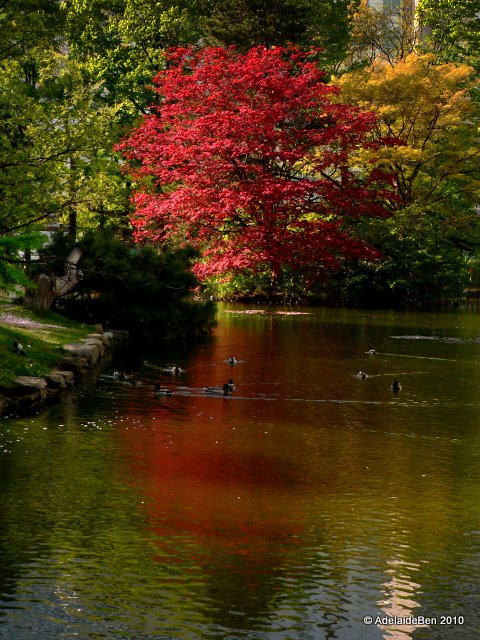
There is a good use of water in various parts of the gardens. Never enough to dominate the experience, but just enough to add a sense of stillness.

And with it you can just relax and let the tension flow out of you as you look at the slow-motion explosion of colours and textures of these flowering plants.


There is quite a large area within the botanic gardens that looks... well... like a forest. In fact, it looks like a perfect place to understand what the natural forests had to offer, without having to go out and find a native forest to go exploring in... as you never know what kind of strange creatures you might come across inside such a forest...

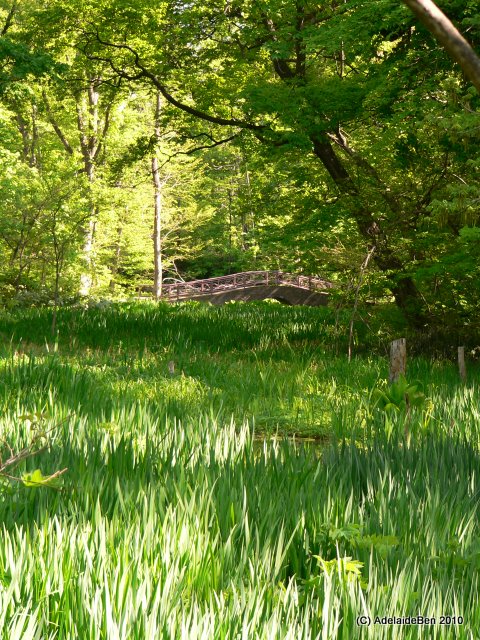
Once again, the use of water, and in this case the grasses that grow by the waterways is quite beautiful. The bridge in the distance just adds to that feeling like you may have just stepped into a painting.

There's also wide open grassed areas within the gardens made from Kentucky bluegrass. Now that doesn't really have a Japanese ring to it.

Lilacs are possibly the most quintessential flora for Sapporo - which is interesting as they're not native at all. Lilacs were brought over from the USA by the Christian educator Sarah Clara Smith in 1890, from which point they spread quite extensively. Whilst the Lilac has now become closely associated with Sapporo (which holds a Lilac Festival later in May each year), it was only selected by popular vote as the symbolic tree for the city in 1960. Actually, T-chan has a slightly tangential association with the Lilac, as she attended the school Hokusei Gakuen Girl's High School which Smith had established along with her Lilacs. During the war, the trees were cut down (not sure if we should read anything into this) - but they sprouted forth once more after the war was over. And so the legend was born.

And whilst the sakura were well and truly past their prime in Maruyama, in the Botanic Gardens they were still going strong...  This variety certainly was vibrant... but completely overpowered by the most beautiful blossom of them all, my gorgeous wife T-chan.


Yet another homework piece.... ah, it's going to be a busy week.

And all the time, the ever present Karasu (or crow) looks on... it's haunting (and let's be honest, annoying) cry echoing across the Park. Actually, this picture might suggest only a single, lonely Karasu... oh no.. there were 10's, if not 100's of them... well at least 10. Karasu are the plague of many Japanese cities for the reason that they are scavengers, and will scavenge in the neighbourhood refuse which is typically gathered in a single spot on the roadside awaiting collection. If the rubbish isn't properly covered, good ol' Karasu will find a way in and before you know it, the rubbish will have found a way out. I think they are pretty well universally despised within Sapporo at least.


Once again, the use of water in the garden is subtle and yet powerful. The elevated path winds through a shallow lake filled with all manner of different water plants. At least we think it was shallow, as we were pushing our stroller with a now sleeping L-kun in it. And a good thing to, as the broadleaf plants are known as skunk cabbage... not something I'd like to fall into.


Our experience of the Botanic Gardens was one of pleasant surprise. It's not a particularly showy garden, and in parts looks downright native. However, as a respite from the city (like it's Adelaide counterpart) it makes for a relaxing stroll, not just through the gardens, but also through a slice of Sapporo history.

Thursday, November 18, 2010

Japan4Kids... A Great Holiday

8th May, 2008 - This trip was definitely unlike any other that we'd experienced in Japan. That's the difference having a small baby can make (especially in close proximity to doting grandparents). To be honest, L-kun has never had so much attention than what he was getting on that first trip... and he was lapping it up.

In Japanese society, eldest sons still have a special place in families... and I imagine eldest grandsons have a similar advantage. Actually, L-kun is the only grandchild on both sides of our family - so there's no competition for attention ever. Spoiling is all too likely, unfortunately.

Travelling in Japan is easy with children... and the quality of children's goods (such as nappies/diapers) is first rate. They were much better quality than back in Australia, and super convenient. The range of strollers was also fantastic... and shopping centres have the cutest free strollers (more of them later). I've already talked about the great range of clothes that you can buy here...super cute! There's also a huge variety of foods in Japan as well... including the ready-made variety... It's very cheap and L-kun didn't mind the change of flavours at all. Ah... we missed that a lot when we came back to Australia. The one thing that we should point out though is that breast-feeding in public is still a little frowned upon (I mean the bare all variety, that is). In Japan, breast-feeding capes are very popular. Whilst T-chan was already reducing the amount of breast-feeding, her feeding cape was still high on her list of must-haves.
Hmmm rice gruel... my favourite!

But one of the biggest differences on this trip was fact that we weren't able to sightsee anywhere near as much as we would normally. Things had definitely changed, and that meant a slight re-adjustment to our own planning (and expectations) as well. To be honest, there were definite advantages... did I mention the special attention that L-kun was getting from grandparents?... That gave mum and dad a little (much appreciated) breathing time as well. Now that's what I call a holiday!

Saturday, November 13, 2010

Ume Blossoms... The Sweet and the Sour of Hiraoka Kouen

8th May, 2008 - After the wonderful experience of the cherry blossoms, we had seen on the local Sapporo news that the Ume trees (I'll explain about ume later) were in full bloom at Hiraoka Kouen, to the south-east of Sapporo. Otousan had very graciously volunteered to drive us there the following day (the 8th)... and we were expecting big things.

View Larger Map

Now I don't want to be overly critical of the Sapporo television channels, but the report that they showed the night before, and what we found were slightly at odds. Instead of being at full bloom, we found the ume to be past their peak. But in true stoic Japanese style, we made the most of what was there. Hiraoka Kouen (park) is a free city-administered park, with some 1200 ume trees. Now ume is known by a few names... Japanese plum, Japanese vine tree, Japanese apricot... well according to my research (it's botanical name is prunus mume) it's actually closer to an apricot-variety that had come to Japan from China a long time ago... And depending on the variety, will either blossom as a pink or a pale green/white flower.

Now the Japanese love to make the most of their attractions. If you're going to see the ume blossom, why don't you eat the ume blossom. I guess it's very efficient. Anyhow, they make ume flavoured soft-cream (ice-cream) for all to enjoy. In fact, today was L-kun's first icecream experience...
And no... I wasn't eating for two... I was holding T-chan's.

Actually, ume is a not uncommon flavouring in Japanese dishes (especially at this time of year). If you haven't tried umeboshi, then I would definitely recommend it. With a warning. I love sour, explode in your mouth surprises. Umeboshi is a sort of pickled ume fruit, which is extremely sour and salty, and might possibly constitute a violation of human rites if forced to eat it. It's sometimes served with meals, or with rice balls (onigiri), and is quite...er... noticeable. It is very Japanese (despite it's Chinese roots), and something you should seek out. Even if it's ume-flavoured candies... which are good if you need to wake up in a hurry.

The flowers were definitely beautiful on the trees that were still well and truly in bloom.

And the variety between colours was also unexpected.

But I have to say that I felt a little cheated that we'd driven all this way based on the news story which had to have been filmed at least a couple of days earlier. Despite the disappointment, it was an enjoyable excursion, and we all had a good time (especially the now ice-cream obsessed L-kun).


And sometimes, when we expect the grand vistas of blooms and find they're not there - we realise that it's not necessarily the quanity that matters. The blossoms are amazine en masse, but the meaning is deeper. This is Spring. The winter has departed. Life re-emerges from it's cold slumber to re-affirm it's dominance over the landscape.

I'm not sure that L-kun was taking all of this in... but there is something singularly beautiful about a tree in full-bloom. Is it really surprising that someone with less than a year's life experience can see this?

One of the things that we saw that day was a school trip, where all the kids had been decked out in their near-matching outfits and hats. As we watched, there was a definite difference in our perspective. Last trip, we most probably wouldn't have given this school group a second thought. Yet now, when we watched, we saw something of L-kun's future. It might not be in a Japanese school, but you never know. The future seems far less abstract once you have your own children. It's no longer like looking through a cloudy window out at some other's world... this was like looking at our future. That sort of thought makes you sit up and notice.

This sort of moment is an umeboshi for the soul!... still plenty of sweet to offset the sour.

Thursday, November 11, 2010

Is This The Best Place for Cherry Blossoms in Hokkaido?

7th May, 2008 - After our unsuccessful attempts to see the Cherry Blossoms previously, we set out again with determination (now that Golden Week had officially finished) to see if we could catch a glimpse of the real thing. Our destination was Toda Kinen Bochi Kouen, near Atsutaka Ishikari.... and this time we weren't going to be disappointed.

The park is some 55km North from Sapporo Station, an inland drive along the coast. It's a pleasant drive... but last time, we turned back just before the bridge over the Ishikari River due to the grid-locked traffic going to the park. About 20 km away from the park. That's Golden Week for you.
View Larger Map

Anyhow, the park has some 8,000 yoshino sakura (I didn't count them all). Many of the trees are planted as beautiful sakura namiki (rows of cherry blossoms) along the roadways. It certainly made for some spectacular driving in the green forested hills of Hokkaido. Perhaps the trees were made more beautiful for the backdrop of green that surrounded them...

Or the deep blue Hokkaido Spring sky....


Either way, these were the sakura that I had come to Japan to see. I was definitely satisfied... arigatou otousan to okaasan! The previous disappointment of Maruyama Kouen and previous aborted drive were wiped away that fine morning.

There are a number of tree-lined avenues that were absolutely spectacular - including one that is about 1 km long and is a veritable cherry blossom tunnel. The strange thing is that whilst common-sense would suggest that you get out of your car and walk... common-sense does not necessarily mean the same thing to all people. So whilst you would be enjoying the beautiful sakura blossoms, you'd occasionally have to get off the path whilst someone drove their car past. Sometimes quite a few cars...
A sakura tunnel

Now... what exactly is this park?... well the observant among you (well, it's not that hard to see) will already know that Toda Kinen Bochi Kouen is actually a cemetery. Yes, we had driven over an hour to walk around the petal festooned paths and roadways of a cemetery. Like the cemetery at Takino, this is a fairly famous cemetery around Sapporo. This one is associated with the Sōka Gakkai, an unusual blend of philanthropic organisation and lay religion (based broadly on Nichiren Buddhism). With approximately 8-12 million followers, it's a significant slice of the Japanese population...and one that is surrounded by some controversy for it's political connections. For me, I am happy to leave those questions to those best equipped to answer them. As such, I can enjoy these beautiful trees with an open mind.

And whilst the tombstones themselves lack the interesting variety of Takino, and the cemetery certainly has a deficiency of Stone Henge's and Easter Island Heads... it makes up for it however in beauty and serenity. There are certainly worse places to rest your weary bones (even if they are cremated).

L-kun, still under 1 year here, and whilst he was sort of interested, his interest was pretty well limited to having Cherry Blossom showers... and when you're 1, why not!

Meanwhile, this is definitely one of the best places to see the cherry blossoms in/around Sapporo if you have access to a car, and don't mind sharing the view with the living-challenged. It's not really a place however to strictly enjoy hanami (normally associated with eating, drinking and being merry). There is still a sombre mood to the park - it is a cemetery after all. There are places where you can eat, or where you can find a seat an have a picnic lunch... 


Is this the best place to view Cherry Blossoms in Hokkaido? Maybe it is the most spectacular (I haven't seen that many), but it may not be able to capture the exuberant atmosphere that accompanies a typical Japanese hanami. It is however one of the most beautiful places to view sakura at their peak in Hokkaido. I'd definitely go there again - just not in Golden Week.