Tuesday, June 22, 2010

Getting Lost and Found in Kyoto


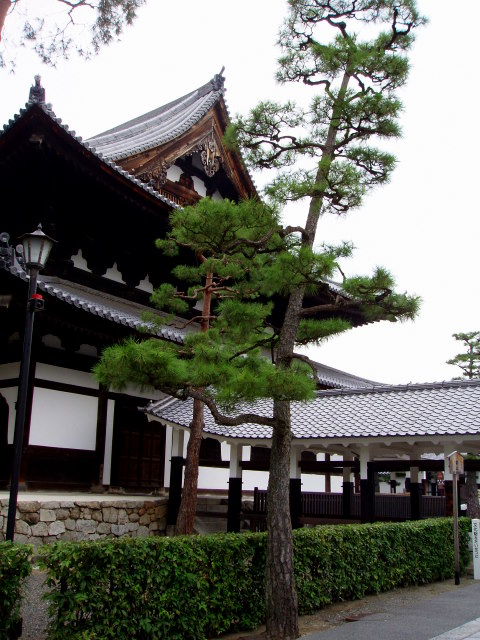
23rd October, 2006 - Across the road from Nijō-jo lies a small garden, Shinsen-en, originally built at the dawn of Heian-kyo, but the present garden dates from Meiji times (late 19th century); a shadow of the previous imperial garden.


There's a small lake and island as the centre-piece of the garden. The island houses a small shrine to a female kami, Zen-nyo-ryu-o.


The bridge is known as the Hosei-bashi, and was quite attractive. It's also nice to find an old-style Japanese bridge that you can walk over. Almost all of the ones previously are blocked from walking over... this most probably indicates the historical value of the garden.


The garden, though small, is nice and secluded... a peaceful retreat. And free.


After we had finished at Shinsen-en, we had one small thing to do... have lunch: Zarusoba (T-chan) and Curry Udon (me). Hmm.. T-chan's pregnancy is starting to work up quite an appetite. Still can't taste a thing though.


Now with a full stomach we set out to find something a little different. Nijo Jinya... an inn dating from 1660, it is famous as for it's ninja-style trap-doors and secret passages... and whilst costing 1000yen, is supposed to be quite good. Normally you're supposed to book in advance, but as we'd been pretty well flat out we'd missed the chance. We thought we'd try our luck.


Hmmm... T-chan... which way is it? Er.... this ain't good.
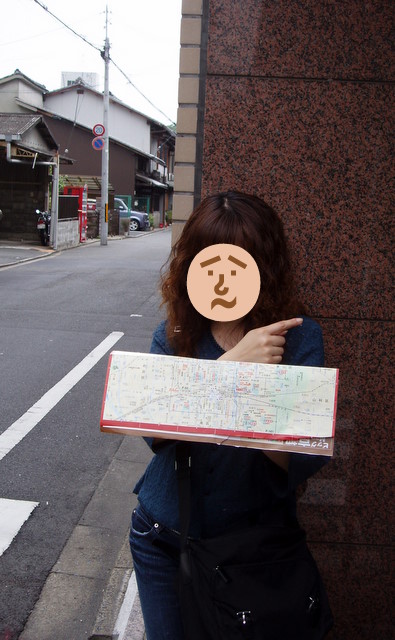

As it turns out... it's actually very easy to get there from (A) Nijō-jo, via (B) Shinsen-en, and then finally (C) Nijo-Jinya.

View Larger Map


The only problem is that we walked past here a couple of times... not knowing. They don't go out of their way to advertise it (maybe why they ask you to book ahead). Street-view was just a twinkle in a deluded mind back in 2006... so we had no idea what to look for, and all the maps were too vague. Anyway... hope this helps people a bit.


In the end we got that confused we started asking locals... you'd be surprised how many looked at us like, "what da hell yo talkin' bout?!?". Apparently it's not that well known locally. By the time we got there - it was way after the tour time was due to start, and it looked decidedly quiet. Once again... booking ahead IS recommended. As is reading the map properly. Feeling a little on the flat side, we decided this was one of Kyōto's sites that would defeat us... this trip.


Jumping on the subway we headed off to do some shopping... and it just so happened we came across Honnō-ji, the location where Oda Nobunaga met his ultimate doom by his own sword. As described previously, Oda Nobunaga - the first grand almost-unifer of Japan - was waylaid by one of his disgruntled generals (Akechi Mistuhide). This is known, unimaginatively as the Incident at Honnō-ji.


Rather than accept the ignominy of such a disgraceful end, Nobunaga ordered the temple set alight and took his own life... though... it should be said that whilst he saved himself the dishonour of having his head taken... his remains were also never found. This apparently is one of the great conspiracy theories of the time... and not a grassy knoll in sight. 


Now - there remains just a small shrine to Oda Nobunaga on site. A small but steady group of people come to pay respects to this great, though fearsome leader. Even in the rain that had started to fall.


The grave of Oda Nobunaga is not particularly impressive - all things considered. He had almost become ultimate warlord of all of Japan. Of course - grand memorials don't generally come to those that almost made it. No matter how grandly.


The temple is hidden away behind a number of buildings, and is not that obvious. Get off at Kyoto Shiyakusho station.

View Larger Map


We quickly made our way down to the shopping district of Kyōto... in particular around the arcades of Sanjodōri and Teramachidōri (named after the concentration of temples that were constructed there following Toyotomi Hideyoshi's reign). I might blog about these later however... today (our third full day in Kyōto) was coming to an end.
Posted by Picasa

Sunday, June 20, 2010

Nijo-jo... A Castle in Waiting...


23rd October, 2006 - We had one major destination today... Nijo-jo... the Tokugawa "castle" within Kyōto. It's not a castle, in the typical Japanese sense (the 5 storied donjon was burnt down in 1750, and not re-built). indeed, I'd be inclined to call it a walled villa these days. It is however an important cultural centre of the city - though the Tokugawa influence was largely exerted on Kyōto from a distance.


 Nijō castle (Nijō-jo) was constructed by Ieyasu Tokugawa after his success at the battle of Sekigahara in 1600. Historically, it was Ieyasu’s powerbase in Kyōto, when he was away from his Kanto homeland. He was proclaimed as the Shogun here in 1603, during his first stay at the partially completed castle. Visits to Kyōto became increasingly rare however as Edo (unofficially) took over the role of capital. He did not return until 1611.


His successor used the castle again in 1624-26 though no Shogun came to Kyōto again from 1634 until 1863 (the sunset of the Tokugawa era). Nijō-jo is however more ceremonial than castle-like, with minimal defences. As such it was meant to impress by opulence rather than by sheer brute force.


The main building within the castle grounds is now the Ninomaru Palace (below). The Palace actually consists of five buildings, each of which was lavishly decorated, and each progressively higher as they move to the inner sanctums of shogun’s world. The first, outer, rooms are decorated more with fearsome (martial) motifs, whilst the inner rooms are decorated in more soothing sophisticated patterns.


The Ninomaru Palace is also famous for it’s nightingale floors which are designed in such a way (sophisticated cantilevered woodwork) as to squeak when walked upon. Unfortunately no cameras allowed inside the palace. The floors - well they do indeed squeak... We should rememeber just how old this building is - and how amazing the craft involved. It would be interesting to imagine the household members sneaking off for a bit of no-good in the quiet of the night.


The gardens of Ninomaru, which are over an acre in size, date back to 1624, and were designed for an imperial visit. Originally the garden was intended to remain unchanged through the seasons, and thus was originally without trees.


Nowadays however, it is based on popular go-round style. The garden centerpiece is a quarter-acre-sized pond, containing three islands – though it was thought to have originally been intended as a dry pond.


The gardens are not spectacular in the sense of many of the gardens in Kyōto, but they have a quiet solidity that suggests permanence and not having to be unduly flashy.


The complex has a double moat; the Ninomaru Palace is the centre-piece of the outer region, and the Honmaru Palace the same for the inner region. 


As Ieyasu had done previously he had elements of his predecessor (Hideyoshi) - including his buildings - dismantled and re-located. Hideyoshi’s Fushimi-jo furnished many of the temples and landmarks around the city with outstanding "additions", including Nijō-jo.


As mentiond, the donjon (or central keep) was destroyed in 1750 when struck by lightning, and the Palace was subsequently burnt down in 1788. The present Honmaru Palace (below) dates from 1847, and was actually the residence of Prince Katsura from Kyōto Gosho which was moved in 1893 when the Imperial family moved to Tōkyō.


I called it the Castle in Waiting - for about 230 years it was a castle without it's lord...Indeed the shogun's return was simply to resign the power of Japan back to the Imperial throne in 1867, dismantling forever the power of the Tokugawa line.


Atop the outcropping, you get a good view of the grounds of Nijō-jo and city beyond. It's not what we had imagined, but was definitely a good experience (though it had been a few spots of rain). I loved the gardens, and it was fun walking inside the Ninomaru Palace with those famous nightingale floors... crying out for their long gone masters, destined never to return.


Posted by Picasa

Nishi-Hongan-ji - Something from the Old School


23rd October, 2006 - It had been a long day, but today was going to be a little more relaxed...for both myself and T-chan.


We had previously visited the Higashi Hongan-ji temple complex the day before. We now arrived at it's twin temple, the Nishi Hongan-ji (the Western temple). The True Pure Land Sect (Jōdo Shinshū) developed out of the beliefs of the monk Shinran (1173 – 1262), who had been exiled from Hiei-zan in 1207. He believed that pure conviction and faith alone could lead to enlightenment in this life, regardless of whether the person was rich or poor. The original temple was constructed in Higashiyama by Shinran’s daughter, however, was forced to move constantly due to persecution (often from other Buddhist temples). Nishi-Hongan-ji was established in 1591 with the support of Toyotomi Hideyoshi - though it was known as simply Hongan-ji then. 


The temple complex is now 27 acres, reduced from the original 80 acres - and the original temple was destroyed in 1617. The Amida-do Hall (above) dated 1760, and alongside sits the main Founders Hall (Goei-do, below) was originally constructed in 1632. Among other things, the temple contains one of the oldest Noh stages in Japan (dating from 1587).


The name Hongan refers to the supposed Primal Vow, Amida Buddha’s promise to save all living beings, and reflects the inclusive nature of the sect. Shinran had a very simple belief... that one heart-felt recitation of the chant "Namu Admida Butsu" was enough to open the gates to the Western Paradise that had been promised by the Amida Buddha. This is chant or or nembutsu roughly translates to "homage to the infinite light".

The sheer simplicity of this belief was in stark contrast to the Pure Land (Jōdo Shū) belief, which had been started by the monk Hōnen, that repitition was the key requirement. It's no wonder why the Jōdo Shinshū was so popular. Very, very simple.


Nowadays there are over 12 million followers and over 10,000 temples across the world... though I have to say, the headquarters here in Kyōto seems far less a temple of the masses these days. Still - it was always wealthy.


The sect became very popular amongst the poorest in Japanese society due to the simplicity of belief-system - and the lack of esoteric practice. Due to the power and wealth the Sect managed to amass, Oda Nobunaga tried unsuccessfully to destroy the sect through military action - but failed. It's hard to believe now, but the monks of Japan were far from peace-loving hippies - they were a feared military force of their own.


Tokugawa Ieyasu, in 1603 also believed the sect to be a threat to his power, but being the devious leader that he was, managed to split the temple between two competing brothers, thus creating the Nishi (west) and Higashi (east) temples that exist today.


Nishi Hongan-ji is only about 500m to the west of it's twin. As far as temples go in Kyōto, this (like it's twin) is not outwardly that impressive; at least not from what is visible to the public. It is however very easy to get to from Kyōto Station, and worth a quick stroll around the grounds and accessible buildings.

Posted by Picasa

Saturday, June 19, 2010

After the Festival: From Shōkoku-ji to Shimogamo-jinja


22nd October, 2006 - After an afternoon of sitting watching the history of Kyōto walking by during Jidai Matsuri, T-chan and I had decided  to make our way to Shimogamo-Jinja... not that far away (or so we thought). It would be good to get some exercise... and we could stop in at Shōkoku-ji to have a look around.


Shōkoku-ji is one of the seven Rinzai “Zen” headquarters in Kyōto, and was also one the five mountains (Gozan). Whilst it looks a little subdued and doesn't appear to get that many visitors, it actually administers both Ginkaku-ji and Kinkaku-ji temples - two of the most famous temples in Kyōto (which we'll come across later). Construction commenced in 1382 AD and was completed in 1392, on orders of Emperor Gokomatsu and with the support of the third Ashikaga shogun, Yoshimitsu.


The gardens are small, but very atmoshpheric. As is often the case, you wonder how they manage to design so much ambience into such a small space. The tree looked incredible - like an over-sized ancient bansai.


It was a great place to just sit back and relax. Like many temples it was all but destroyed in the civil wars of the 15th century, during the Ōnin Wars. The current buildings date from 1807. The grounds also includes buildings of the former Imperial Palace, Kyōto Gosho.


I'm a big fan of the courtyard gardens in Kyōto, where the simple arrangement of rocks, bamboo and gravel can have such a simple pure effect. Unfortunately for me, when I try to do this, weeds are added to the equation...


The difficulty is always switching off and finding the moment of peace within. 


One of it's "features" is a hall where a huge dragon (painted by Kano Mistunobu at the start of the 17th century) had been painted on the ceiling - and the amazing acoustics associated with clapping underneath it... supposedly you hear the dragon roar. You pay to enter the hall, and the guide instructs you on where to stand, looking up, you give a good old clap. Roar? Indeed, there is a lot of echo in the hall... but it's not something that left me feeling the hot breath of the dragon on my neck. Unfortunately no cameras allowed... but you can find photos around the net.


View Larger Map

By this stage we had started to run our batteries down... but we were over half way to Shimogamo-Jinja. Or so our tourist map indicated. We set off again... it was now after 4pm. Don't forget, T-chan was 2-3 months pregnant, and not exactly feeling chipper.


We almost gave up - but finding that giving up meant walking just as far backwards we continued on. We finally arrived... well after 5pm. The shrine itself is approached from the south, through the Forest of Correction (Tadasu-no-mori). Legend tells that this peaceful forest is a place where lies cannot be told. Hmmm....best to get through here in a hurry. We reached the huge vermillion torii gate with the steady passage of visitors reassuring us that we weren't too late.


Before the creation of Kyōto, there existed a number of different tribes/clans in the Kyōto basin. One such group were the Kamo, which had migrated from the Yamato region. They were living in the region where the two rivers, Kamogawa and Takanogawa converge. Shimogamo-Jinja (also known as Kamomioya Jinja) is therefore one of the oldest of the shinto shrines in Kyōto (indeed it pre-dates the city by several hundred years). The shrines enshrine Tamayori-hime and her father Kamo-Taketsunumi-no-Mikoto; the ancestors of the Kamo clan.


Shimogamo Jinja is a good example of the nagare-style in shrine design. This style was developed after the arrival of Buddhism in Japan, and was strongly influenced by Chinese architectural style.


The shrine is one half of a pair... The older, sister shrine, Kamigamo Jinja (to the north west), is dedicated to the god of thunder, Wakeikazuchi. The shrines used to fall under the Shikinen Sengu, and were required to be re-built every 21 years. Nowadays however they are merely rennovated every 21 years. 


The Maidono is now sometimes used for dance-recitals. Notice the nagare-style curved gables... 


Time for some purification.


We felt really satisfied with ourselves, having made it all the way here... 


...but about 30 seconds after this photo was taken our energy faded completely, with the last rays of sunlight. The journey back to the apartment was very quiet - we were completely spent. No time for going out tonight...
Posted by Picasa

Thursday, June 17, 2010

Jidai Matsuri pt 4... The End and Beginning of an Age


22nd October, 2006 - This is phase is known  as the Enryaku Period - and back on familiar ground, we see the march of warriors...


Being led by Sakanoue-no-Tamuramaro, the military leader at the dawn of Kyōto, or Heian-Kyo... the Capital of Peace and Tranquility, as it was known. Somewhat ironic? He was one of the original Shogun of Japan, tasked to subdue the native Emishi in the north of Honshu. Shogun is the shortened form of  seii taishōgun, which means "great general who subdues eastern barbarians". This was the favourite past-time of generals in Japan over many hundred of years - and continued only until only the Ainu of Hokkaido were left to subjugate.... and then there were none.


It had however been a very long day already.... and all that subjugation can take it out of a man. No matter how strong his samurai spirit.


Following the passage of the warriors, we see the march of the court nobles. It would appear that the concept of convenience had not quite come into Japanese umbrella design by the early Heian period... just joking!


An important part of the precession is the Offerings to the Deity... and we know that the best place to officiate offerings from is horseback... actually - horses were common offerings to shrines in olden times. What they did with them, I don't want to know... Indeed horse offerings were the original source of the more modern ema board offerings you see today.


Whilst those exorczing evil spirits with their tamagushi, made of Sakaki branches decorated with shide paper didn't look quite as jovial. The Sakaki tree (Cleyera japonica) is sacred to the Japanese Shinto religion, even figuring in the creation myths recorded in the ancient book, the Kojiki.


Of course, you can't have a grand-finale without just a little more colour and music... no, we certainly haven't had enough colour yet... have we? The next segment of the parade is called th Zen-Retsu, who offer both music and performance to herald the approaching deities...

In the mean-time we have these wonderfully (but somewhat strangely) dressed boys... are they angels, I hear you ask? I dunno. This one certainly didn't look too heaven-sent if you ask me. In fact he looked like he knew exactly how long the day was going to be. Only 1,745 m to go.


His friend looks a little too self-assured by contrast.


The Zen-Retsu continues with the approach of the musicians....


A potent music rings out across the path leading from Kyōto Gosho... the former Imperial Palace. This amazing looking instrument is known as the shō, and dates from the dawn of Kyōto (though was derived from an earlier instrument imported from China). Apparently the sound is supposed to imitate that of a Phoenix (er...ok)... and the two largest pipes are actually silent - but representative of the phoenix wings (no really... Wikipedia... are you making this up?).


And if that didn't do it for you, there's nothing like banging the gong to let you know that Deity approaches....


My first (embarrassingly bad) vid of the Zen-Retsu...

(I might throw in a vid or two on earlier posts now...)

Finally the climax of the parade. The Shinko Retsu. The Precession of the Sacred Carriage. First we meet the spirit of Emperor Komei (1831 - 1867 AD)... in typical anti--chronological fashion for Jidai Matsuri - the last Emperor to reside in Kyōto comes first. Whilst their spirits normally reside in Heian Jingu, they are able to get-out-and-abooot through the use of these portable shrines (mikoshi). Handy. In Japanese belief, their spirits have become kami - godlike beings in the pantheon of gods that the Japanese worship. But these gods are more like the gentle-autumn-breeze rather than the smiting-from-up-high-variety.

I'm not sure what the significance of the two objects are that follows...my research wasn't thorough enough at the time, and Google-sensei has sadly failed me at the last. Also, I'm not sure if there is significance in the riderless horse. I'm assuming he hadn't just fallen off. Please oh please - if you know, drop me a line.

Following in quick order is the spirit of Emperor Kammu (737 - 806 AD), the first Emperor of the city of Heian-Kyo. Kyōto . Kammu was an unlikely Emperor in that he was supposedly directly descended from Korean royalty through his mother's side. Also, Kyōto was not his first choice of location for his capital... initially he'd moved from Nara (hot-bed of Buddhist power as it was) to Nagaoka... but after a series of disasters befell the Imperial family, he naturally thought (only 10 years later) it'd be best to do the whole relocating the capital thing again... to the site of Kyōto. And here the capital stayed (from 794 to 1867 AD)... just a little while.


The Japanese Phoenix, or as it's more correctly known, Hō-ō. It's synonymous with the coming of a new era or the birth of a particularly auspicious ruler. Certainly Emperor Kammu had left his indelible mark on the country through his legacy. His city.


Once again, not to be outdone, Emperor Kammu also sports a couple of...hmmm... er.... those things.

Of course, we couldn't end the parade there... following up the mikoshi comes an army of flower-carrying obasan. 

So Jidai Matsuri doesn't end with a bang, but with a boquet... not quite what I was expecting...


Thus ends my posts of Jidai Matsuri... what a journey!

 We had a good day, and it was well worth the price of the ticket (about 2000 yen, which includes the reserved seat and nice glossy and informative program). I know that it's also possible to see the parade wind it's way through the streets of Kyōto, but to my mind,it's much more comfortable getting a seat and enjoying the whole thing in a more relaxed way. Take some food and drink... it's a long afternoon.... and it had only just started for us.
Posted by Picasa